
Principal Analyst
For years, the center of gravity in higher education technology strategy has been relatively clear.
Institutions invested heavily in student information systems, learning management systems, and CRM platforms to modernize the student lifecycle. Vendors built ecosystems around these core platforms. Technology roadmaps often revolved around replacing or upgrading one of these major systems.
And in many institutions today, SIS modernization remains a major priority.
However, the pace of modernization across the market is uneven. In the United States, only about one-third of higher education institutions have made a formal decision to modernize their student information system. Many institutions are still evaluating their options, while others continue to operate legacy platforms that remain deeply embedded in institutional processes.
For institutions pursuing modernization, replacing a legacy SIS can deliver meaningful improvements in usability, integration capabilities, and access to modern cloud architectures.
But a different set of conversations is also emerging across institutions.
Increasingly, technology leaders are discovering that some of the most complex and limiting challenges in their technology environments are not tied solely to the SIS itself.
They are tied to academic operations.
Academic operations has historically been associated with the student information system. Scheduling, curriculum structures, program requirements, and degree progress were often assumed to be “handled by the SIS.”
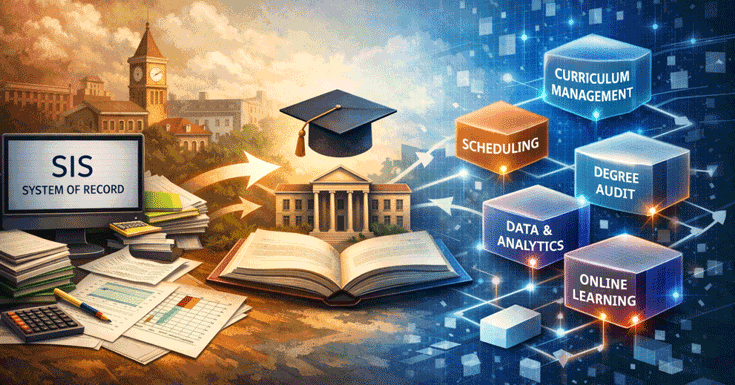
In reality, the SIS primarily functioned as a system of record.
The workflows and processes that supported academic operations frequently existed outside the system itself. Curriculum approvals moved through committees and governance structures using documents and email. Scheduling decisions were coordinated across departments using spreadsheets. Program structures and policy interpretations were often maintained through locally managed files or institutional knowledge.
For many years, this hybrid model worked well enough.
But the structure of academic programs and student journeys has changed dramatically.
Institutions now operate in an environment defined by:
As these changes accelerate, institutions are discovering that the informal systems supporting academic operations were never designed for this level of scale, speed, or complexity.
The result is growing friction across the institution.
Many institutions are encountering the same pattern.
Academic leaders want to introduce new types of programs, flexible pathways, or alternative credential structures. However, when these ideas reach the implementation stage, the underlying technology environment struggles to support them.
Even institutions pursuing SIS replacement or modernization often discover that a new platform, while valuable, does not automatically resolve every challenge tied to academic operations.
Common examples include:
Replacing a legacy system can address many technical limitations. But modernization rarely depends on a single platform alone.
It depends on how the broader academic operations environment evolves alongside it.
This is beginning to change.
Across the higher education technology landscape, a growing number of vendors and institutional initiatives are focused specifically on the capabilities that support academic operations.
Areas that are receiving increased attention include:
These capabilities are increasingly being addressed through platforms that operate alongside the SIS environment.
This shift reflects a broader architectural change.
Rather than expecting the SIS to handle every operational process tied to academic structures, institutions are beginning to distribute these capabilities across a more modular ecosystem.
Over the next several years, institutions will likely spend less time debating whether the SIS alone can deliver modernization and more time examining how the broader academic operations environment should evolve.
This will involve questions such as:
These questions sit at the intersection of academic governance, institutional strategy, and technology architecture.
They also represent some of the most consequential technology decisions institutions will face in the coming decade.
Because modernization in higher education will not be defined by a single platform decision.
It will be defined by how institutions rethink the capabilities and systems that support academic operations across the student lifecycle.
Originally posted by Matthew Winn on LinkedIn. Be sure to follow him there to catch all his great industry insights.
Share Article:

© Copyright 2026, The Tambellini Group. All Rights Reserved.
Get exclusive access to higher education analysts, rich research, premium publications, and advisory services.
Weekly email featuring higher education blog articles, infographics or podcasts.