
Author
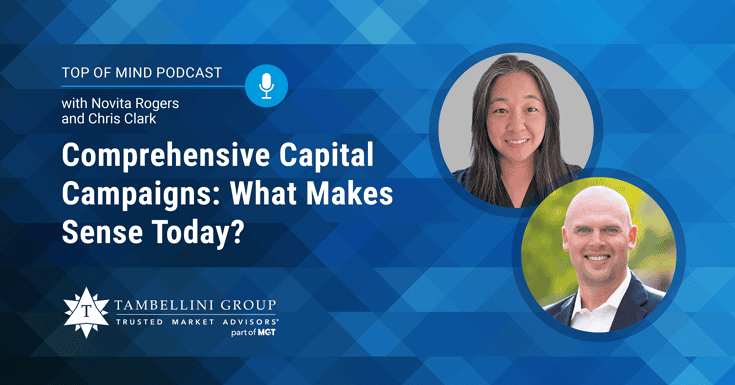
For long-term success, higher education leaders can’t treat capital campaigns as standalone fundraising drives. They need connected, data-led strategies that align advancement, finance, and academic priorities. In this episode, Salesforce’s Chris Clark and Tambellini’s Novita Rogers show how AI, structured data, and strong governance turn one-off asks into personalized engagement that drives long-term institutional growth.
Novita Rogers (00:06):
Hello and welcome to the Tambolini Group Podcast. I’m Novita Rogers, senior analyst at the Tambolini Group. In my role, I spend a lot of time talking with higher education leaders and partners about what’s changing across the ecosystem and what’s actually working in practice. Today’s conversation is intentionally not about any specific product. We’re focusing on comprehensive capital campaigns through a lens that prioritizes people, process, data, and technology. Before we jump in, I want to underline why this matters. Advancement is mission critical to institutions and the goals they’re trying to achieve from student access and success to academic priorities, research, and long-term financial sustainability. Fundraising and campaigns are not side initiatives. For many institutions, they’re one of the most important levers leaders have to shape outcomes and expand what’s possible. I’m joined today by Chris Clark, Senior Director of Product Management at Salesforce Education Cloud, and someone who’s deeply knowledgeable about this topic.
(01:13):
And I’ll share a bit of context on why we’re here. In my first conversations with Chris, he consistently showed a real energy and conviction when the topic of comprehensive capital campaigns came up. It was clear he had a strong point of view, but we never had the time to really dig in. So I wanted to create the space for a deeper conversation and just as importantly, share Chris’s perspective with the broader audience of leaders who are thinking about campaigns right now. At a high level, we’re going to unpack what comprehensive campaigns really are and why this approach is especially relevant right now. Chris, before we dig in, I’d love for you to share your background, what brought you into this work and what experiences shaped why you’re so passionate about comprehensive capital campaigns.
Chris Clark (02:00):
Oh, well, thank you for allowing me to be here. It’s really an honor to be able to speak with you about this. This is something that I’ve been passionate about for decades. I’ve been at Salesforce for about seven years. Prior to that, I spent 21 years in either fundraising or finance. So to say that fundraising is in my blood is an understatement. So half of my mind is all about fundraising, and then the other half of my mind is all around finance. And thinking about the intersection between those two areas is really important, especially because of the demands that are happening today. I think the reason why I’m in education and why I serve the education market here at Salesforce is that I want to be who I needed when I was younger. When I think about the experiences that students like my own children are going through through K through 12 and through college now as they age, I want to make sure that they have the best possible experience.
(02:56):
When I think about the role that philanthropy can play in that world, philanthropy is actually two Greek words put into one. It’s love and it’s humanity. So when we actually think about the love of humanity, I think that’s really a great way to talk about philanthropy, which is what we’re here to talk about today.
Novita Rogers (03:19):
I love that, Chris, because as we talk about higher education, sometimes we get so mired in, at least in my discussions, in the technology and the processes and things. But the reason a lot of us joined higher education is because of the people and the students and the faculty that we so deeply care about.
Chris Clark (03:38):
Yeah, you’re absolutely right. And I think about if I can make my children’s experience better, we can also help all of the youth in this world. And forget about just you, think about how you and I go and do executive education or continuing education or lifelong learning and what experiences we can provide. And I honestly believe that in the role that I’m in now and working for the company that I do, it allows us to take these experiences from all kinds of different sectors and then deliver them into what we call education today. When we think about a comprehensive capital campaign in particular, it’s really think about how do we connect all these different pieces and then deliver that to the institutions of this world.
Novita Rogers (04:27):
So let’s talk about that. When you say comprehensive capital campaigns, what does that mean in practice and how does it differ from traditional campaigns?
Chris Clark (04:36):
Yeah, I think it’s a great question. When I say comprehensive, I don’t just mean a large fundraising goal. I mean something that’s integrated a comprehensive campaign, it aligns more than just fundraising. It aligns things like academic priorities and financial strategy and things like research intelligence and execution from the advancement teams and governance all into one larger effort. I think that it’s not necessarily advancement owned, it’s institution owned. One of the things that I’ve been following quite a bit is that we’re also starting to see the rise of what’s called the modular campaign design, where it’s not just a capital campaign, because underneath that umbrella, there’s often multiple initiative level micro campaigns. So think about sustainability and workforce development, research innovation, student access, and they each reach and resonate with different constituencies within the institution, the community and everything else. I believe that the future comprehensive campaign feels less like a seven-year sprint and more like a coordinated portfolio of mission aligned initiatives almost that are operating continuously.
Novita Rogers (05:54):
Yeah. So can you tell me, we’ve been in this world of campaigns, right? Those seven-year sprints that you just mentioned, but why is this approach that you’re talking about relevant right now?
Chris Clark (06:08):
Yeah. Okay. I think this is fantastic because when I think about enrollment pressures and think about public funding uncertainty and these different expectations around outcomes, and I’m not just talking about outcomes, I’m almost talking about measurable outcomes. And at the same time, we also have to think about this great wealth transfer that’s happening between generations. So when those two things intersect, people expect hyper personalization. They also expect things like making sure that their values are aligned with not just the greater campaign, but all of these sub-campaigns. And then, which is probably the most important thing for the generations that are entering this world of participating in comprehensive campaigns today, is transparency. I feel that comprehensive campaigns are facing almost like this forcing movement of strategic clarity because they have to align philanthropy with that institutional priority that helps with that long-term planning.
Novita Rogers (07:21):
You mentioned that generational wealth transfer. Do you have a viewpoint on what that looks like outside of higher education? Because what I’ve been reading is there’s a lot of philanthropy happening around the world in all these different sectors, but it feels like higher education is struggling a bit in this. Can you talk to what you’re seeing globally in other sectors and how that translates to what’s happening in higher education?
Chris Clark (07:50):
So a couple of different ways to look at that. One is think about what’s happening from the financial sector. So the financial sector is understanding about this generational great wealth transfer, about how funding or funds is being transferred from one generation to the next. So when you think about wealth planners and you think about investment teams and you think about that, they’re embracing this concept of the great wealth transfer. And for those of you, I think we’ve all heard about this at this point, but over the next 20 to 25 years, about $84 trillion will be transferred from the silent generation and the baby boomers to the Gen Xers and to the millennials. And of that $84 trillion, we expect about $12 trillion to be transferred into philanthropy. And from a philanthropy perspective, that’s not just higher education. Like you mentioned, it’s also religious causes and it’s human services and it’s traditional charities and it’s those different types of things.
(08:51):
But if we’re not prepared for that the same way that financial institutions are preparing for that right now, then we need to start preparing for that. One of the interesting things is I believe that higher education actually has a unique opportunity here. And the reason why is, let’s take my son as an example, he’s a little bit of an overachiever. He applied to 19 universities. And by applying to 19 universities, he built a relationship for six to 12 months and did that through the recruiting teams. And then he was accepted into one university. So he’s going to have a relationship for that one university very intensely for about four to five years. Then after that, he gets into the alumni space. And a lot of philanthropy, we think about it from the alumni perspective, but he’s going to have a relationship with his school for 30, 40, 50 years.
(09:52):
So if we think about all of the interactions or contact reports and we think about all of the indicators and occurrences and assessments and long-term relationship building and short-term relationship building and marketing campaigns and all those different types of things, we may greatly understand individuals better than the financial sector. We may greatly understand the people around these folks better than these other different pieces. So as we prepare for the great wealth transfer, and it’s not enough just to be prepared for it today, it’s happening right now, we might understand people better.
Novita Rogers (10:36):
It’s so interesting because like you said, you have that relationship, a person has a relationship when they first enter college, but also sometimes before that, right? My parents went to our local community college,
(10:51):
And then I ended up going there when I was in high school to take some classes while I was in high school. And so some people really have that relationship when they’re very young and may go into that college and then just beyond that for alumni, like you say. Along those things, I love what you said about higher education really has that deep wealth of knowledge about a person. And you talk about personalization towards them. So using what higher education knows, but also some of the learnings that we can take from other industries and sectors that run these large scale fundraising and capital campaigns, what are some practices you think that we could take from those other industries or that you’ve seen in your work into higher education industries?
Chris Clark (11:39):
Yeah, I think that’s great. So one thing that I want to make incredibly clear is that higher education doesn’t need to copy from other industries, but it can learn from them. And we talked about finance a few minutes ago, but finance has long treated capital as a portfolio. So they balance things like diversification and risk and return. When we think about healthcare, healthcare integrates operational and philanthropic data to support engagement. So when you think about grateful patient and you think about those different types of things, and then when we think about things like subscription models, and Salesforce knows a thing or two about subscription models, but subscription models, they almost master this lifecycle engagement and renewal discipline. The future of comprehensive campaigns may function less like a singular fundraising event, and I know that they do today, but more like this diversified portfolio of what I like to call mission aligned capital.
(12:40):
And it’s not corporatizing philanthropy. And I know that we’re all kind of risk adverse to thinking about that, so I want to make sure that that’s clear. It’s not corporatizing higher education, but what it’s doing is it’s modernizing things like stewardship, it’s modernizing things like governance, and it’s looking at it from a much more structural discipline. It’s interesting because at the most basic level, when you talk to someone about a fundraising campaign, forget about comprehensive capital campaigns just for a second, but you go to a local school event and you see the thermometer, and that’s something that the public thinks about from a fundraising perspective. When we think about a comprehensive capital campaign, especially the comprehensive capital campaigns of the future, they look much less like a thermometer and they look much more like a diversified portfolio. In fact, they look more like a ledger.
Novita Rogers (13:40):
Can you delve into that a little bit more?
Chris Clark (13:45):
Yeah. I think that instead of looking at the end goal, and we have to look at the end goal and we have to celebrate the end goal and we have to talk about the end goal and we have to champion the end goal and we got to get everyone excited about this billion dollars or half a billion dollars or a hundred million dollars or all these different types of things. Instead, it’s probably 20 or 30 goals within that billion dollar goal. And Navita, something that might be important to you might be less important or more important to someone else. And as we hyper personalize campaigns for those segmented audiences, it’ll begin to look like many smaller goals into the bigger goals. And successful comprehensive capital campaigns do this today. I think though that as people are more focused on this impact giving and this impact portfolio, and as people get smarter with their money, we have to start thinking about it from a hyper-personalization perspective and think about it as a lot of small goals that turn into this diversified portfolio or the thermometer of the future.
Novita Rogers (14:55):
Okay. Yeah. And I mean, one thing that you said earlier was about the hospital industry and the grateful patients. And I think about that a lot having had experience with that and how grateful I am to the nurses and the doctors and things like that. And in higher education, I think about, wow, I’m so grateful to this particular professor. They really helped me either in mentorship or helped me grew in my degree and where I am today, things like that. And I can see what you’re talking about, Chris, where it’s not just the seven year, $2 billion campaign and get there to the end however you get there, but the building on that personalization. I may not care about the larger goal that may not be where my passion is, but if I can help fund that chair, that endowed chair for that professor that I really care about, I will do that.
Chris Clark (15:50):
Right. And I think you’re now heading into this idea of restriction, right? Where restricted funds and I want to give to this specific cause and those different types of things. And I’d like to share with you that restriction isn’t the problem, it’s misalignment is the problem because I believe that modern philanthropy, and we know this already, is increasingly complex. So we’re talking about plan gifts and donor advice funds. We could talk for an hour about donor advised funds, family offices, and it requires this very disciplined modeling and it’s also governance. But I feel like institutions need to move beyond this transactional thinking and treat restriction management as almost like a portfolio oversight. So when institutions structure research profiles and preserve things like institutional memory and document relationships and think of the intelligence and everything else that can come from all that, they can align donor intent with the long-term sustainability of this campaign and also honor that restricted giving.
(17:01):
Restriction isn’t the problem misalignment is. Strong governance and intelligence enable that flexibility without compromising intent. So if you were to make this gift, let’s say you’re going to make a $10,000 gift to a cause that is incredibly important for you, as you think through these multiple campaigns, maybe hundreds of campaigns that are part of this comprehensive campaign that allows the institution to understand not just what they need today, but also almost like see the foresight of understanding what they need in the future. I think that I believe that campaigns amplify the strategy they don’t create it. When you think about the strategy of an institution and you think about the strategy that we need in order to sustain ourselves for the next hundred years or 200 years or 50 years, we have to think about that strategy first. The campaign can amplify that strategy, but it can’t create that strategy.
(18:08):
The campaign supports the strategy of the leadership. It doesn’t create the strategy.
Novita Rogers (18:15):
That should be the goal of all of our work that we do in higher education and our jobs. Yeah,
Chris Clark (18:20):
Exactly. Exactly, right. Well, what’s my 10-year goal? I guess maybe you and I will have another podcast about the 10-year goals for ourselves, but if you think about it seriously, it’s like what we do today needs to amplify what our 10-year goal is. What we’re doing with our roles and our job and our professions, how does that fit our 10-year goal? How does that fit our 20-year goal for our families and our children and our spouses and partners and all those different types of things? The same exact thing happens with a campaign. Comprehensive capital campaigns, they almost force strategic clarity. They don’t create the strategic clarity, but they can force it. And what it does is it makes it so that the philanthropy that’s happening at the institution is aligned with the institutional priorities. And if we can find the individuals and the groups and the other people that are in the orbits of these institutions, they can help serve that mission, they can help push that mission forward and they can help execute on that strategy.
Novita Rogers (19:27):
So I love this. Let’s dive a little bit even deeper into this. So as we talk about that
(19:35):
Campaign, what does a strong campaign operating model look like? You’ve talked about governance several times, but thinking about that, what should leadership think about in governance, decision rights, aligning across campus? We talk, especially I think governance, we say it so much and I think everybody knows it, just like everybody knows I need change management, but actually doing it and making it come to fruition and getting that cross campus alignment takes a lot of work, especially in higher education. So can you talk a little bit more about how do we make a strong campaign for institutions?
Chris Clark (20:20):
When we think about our customers and we think about the institutions that do this really well, it obviously starts with governance clarity, something that we’ve been talking about, but it also requires executive steering and things like defined decision rights. Who can make the decision? Why are they making the decision? And it’s also about consistent performance. And it’s not just performance, but also like what I call performance cadence, like making sure that it’s happening at a certain level. Advancement teams can’t operate alone. It requires finance and academics and research intelligence and leadership. And I know I’m not saying anything that anyone doesn’t know, but it requires for all of those to be aligned, and that is something that’s hard sometimes. And when I think about it, I think about it as like campaign government should almost resemble endowment governments. So it needs to be disciplined, it needs to be continuous, and it needs to be transparent.
(21:15):
So when we think about things like structured workflows where we move prospects through research and qualification and cultivation and stewardship and all those things that we talk about all the time, we have to do so almost like in a predictive way. So when campaigns rely on the institutional systems in which they’ve created, rather than what I would almost call like individual heroics, they scale discipline, repetition, transparency, and having this cadence of performance allows us to move forward. And I think it’s important because it should look much more like a endowment than almost like a special event. And I know that comprehensive capital campaigns aren’t a special event, but sometimes you might think of them as a seven-year event or a seven-year campaign. It should be more disciplined. It should be more transparent and it should be done as the whole institution and not just the advancement team.
(22:24):
The ones that are successful are doing it together.
Novita Rogers (22:29):
That’s interesting. What do you think about the data that we have around this, the insights that can be used? What information is critical for these campaigns to run well?
Chris Clark (22:42):
Yeah, so this is probably my favorite topic because it’s something I work on every single day. I believe that the most important data in a campaign isn’t the dollar raise, so that’s not the thermometer. It’s what is the structured intelligence about things like the health of the pipeline, concentration risk, and then the long-term donor capacity. Having someone participate in a campaign isn’t the end goal of the campaign. It’s how do you grow them and how do you grow the relationship so that they can also participate in the next campaign or how to get the family into the next campaign? So what is needed, and by the way, it’s also to grow the next generation of lay leaders who can help lead that campaign with institutional staff going forward. So institutions really need that visibility into things like early indicators and understanding things like wealth events and formal assessments and things that we’ve talked about before, also to think about what those philanthropic milestones are.
(23:47):
I think that we all know this, but when I think about the worldview and the work that I get to spend time on every single day and speak to institutions all over the world, every single day, most institutions don’t lack data. They’ve got tons and tons and tons of data, but sometimes they lack the consistent definitions and what shared meaning means across systems because we speak with people that they’re bringing in a hundred different systems into their advancement systems and they might be bringing in 20 or 30 different research systems into their advancement systems. And when I think about structured research signals and unifying that with things like engagement history and financial reporting, and that is really what gives leadership the confidence in forecasting. And then that dreaded term that we talk about all the time is like risk management. I think that the biggest thing out of this part of our conversation is that, and I’ll just repeat it one more time, is that most institutions don’t lack data, they lack their shared meaning.
Novita Rogers (24:56):
I agree with you. Looking at data and looking at data conversion and all of that stuff, there is so much data out there, but also there’s a lot of data that stays within people’s minds because sometimes it’s hard to find the time to write those notes out, but also sometimes there’s so many notes and I can’t parse through all of that. I want to just touch on some of the technology that you’re seeing and what you seem upcoming, and I’ll say the words AI. How can technology help in parsing through all of that information and helping institutions understand what can be used and maybe what other pieces of information we may want to talk to our community about?
Chris Clark (25:43):
Yeah, I think that’s a great question. And I’m going to say something that might be a little controversial, especially because I work for a technology company, but technology maturity is not about the tools. It’s about the workflow discipline. So when we think about how we use technology, we have to be disciplined in using that technology. And we talked about change management a few minutes ago. Change management is hard. Now, comprehensive campaigns do give an opportunity to introduce change management and do give the opportunity to introduce new tools and new technologies and things like that, but they have to be disciplined in using the technology. So capturing that contact report, I remember when we used to just do it in like we’re processing system and then we did it in a CRM, but the contact reports of the future are just on the phone, like you talk to your phone or maybe it’s taking notes.
(26:43):
And then maybe Novita, I’m sitting down with you and your family in your living room and we’re talking about how you can participate in this comprehensive capital campaign and it’s a ledger, it’s not a thermometer. And I need to know everything about you before that meeting, but I don’t have five hours to read every single thing you’ve done with your alma mater during that time. So instead, I’m going to summarize that information. I’m going to ask questions of that information. I’m going to do the campaigns of the future will do less clicking of going to those 50 different entries and it’s going to do more thinking. We’re going to have a thought partner with our technology prior to the relationship officer going into your living room and having that conversation. We’re going to be able to ask questions of that data. We’re going to be able to ask, “Talk to me about your interests.” We’re going to be able to ask, “Talk to me about your last five gifts.
(27:37):
Talk to me about what do we predict that you could do over the next five years? Talk to me about your family. Talk to me about all those other things.” It’s less clicking and it’s more thinking. And even though I said at the beginning that technology maturity is not about the tools, it’s about the discipline, we still have to be able to use those tools in the best way to do what philanthropy means. At the beginning of this conversation I shared, philanthropy means the love of humanity. We have to use these tools ethically. We have to use these tools for human good. We have to use these tools so that we can fulfill this love of humanity so that we can help for the scholarships of the future for our children and our children’s children and for the children of the world. And we have to use these tools to endow those brilliant professors and allow them to impact the youth of this world.
(28:44):
You’re not going to get that by looking at 50 different things on a screen. You’re going to get that by having a conversation with the data. That’s why we have to start thinking about these tools from an intelligence perspective instead of just from a dashboard perspective or from a report perspective. And obviously everyone needs reports and dashboards. I’m not saying that, but to have that conversation of the future and then to have the discipline to use those in the right way to advance the mission of the institution.
Novita Rogers (29:22):
Earlier this week, Chris, when we were talking, you said, “We’re moving from clicking to thinking.” And I wrote that down because that really just stuck with me. And I’ve been thinking about it all week. And as we go into this world of AI, now go, we’re in the midst of the world of AI.
Chris Clark (29:39):
We’re just at the beginning of it.
Novita Rogers (29:41):
Yes, it’s constantly changing.
(29:44):
I’ve been thinking about that a lot, right? How does AI change what we do? And there’s a lot of just fear for some people about, how does AI change my job? Isn’t it going to take things away? But when I think about what you said, we’re moving Going from clicking to thinking, and I think about my prior experiences working with advancement offices on the technology front. There was so much time that the teams were taking trying to find out information about people. And Chris, exactly what you said. I don’t have time to read through hundreds of notes to figure out I’ve got to talk to this person the next hour. And I love the idea of being able to use systems to say, these are all the things we already know about the person and have it help me understand who you are, Chris, what we’ve already learned about you, what we know about you, because higher education and the work that’s being done in advancement is a trust relationship.
(30:41):
We’re building relationships with people with people because it’s not for the fundraising aspect of it, but it’s for what we care about as an institution, our mission, our goals, and how we can continue furthering the mission of teaching and learning, of research, of the specific things that each individual institution cares about, and those people out there that care about that mission as well and bringing them together.
Chris Clark (31:13):
Right. No, and I’m just writing down some notes here because you said some things that I think are really interesting. I don’t think that technology will change what we do. I think technology will amplify what we do. And I was very serious when I said we’re just at the beginning of this AI adventure, especially when we start thinking about it from a philanthropic perspective. The relationship building between an institution and the people that love and believe in the values and the mission of those institutions, that relationship will never be replaced by technology. That relationship can be amplified with technology because at the end of the day, advancement doesn’t mean fundraising, and it doesn’t mean communication, and it doesn’t mean volunteerism, and it doesn’t mean engagement, and it doesn’t mean marketing campaigns, and it doesn’t mean making the donor pyramid, and it doesn’t mean … Of course, it means all of those things.
(32:08):
But advancement, we use the word advancement intentionally, because it means to advance the mission of the institution. Advancement is advancing the mission of the institution. Philanthropy, the love of humanity, helps fulfill the advancing the mission of the institution. Technology can amplify that. It will never replace the intent that a family, or an individual, or a group of people make to advance the mission of the institution, but it can certainly amplify it.
Novita Rogers (32:50):
Yeah. So I mean, Chris, this is why I love talking to you. It’s just the passion and the knowledge about this. Previously, you talked about the workflows that are really needed. And what are the most important workflow capabilities you believe are most important to support the campaigns end to end? And then what bottlenecks do you see most often?
Chris Clark (33:12):
I think it’s interesting because a lot of times we’ll talk about the fundraising cycle, so identification, qualification, solicitation. And I think I skipped a couple steps in there. I haven’t had all my coffee yet today. I actually think that the biggest bottleneck and the biggest step that is missing is stewardship. I believe that we have the data, we’ve identified the people, we can qualify them, we can solicit them, and we can do so in a loving and a meaningful way, but stewardship is so important. And it’s not something that we talk about a lot, but I do think it’s important because a little while ago, I mentioned that the goal of having someone participate in a campaign isn’t just to have them donate to the campaign, it’s to have them feel like they have a sense of belonging and ownership over the results of the campaign.
(34:08):
It’s allowing them to understand that they’re making an impact and an investment in the mission of the institution, but it’s also to identify who the lay leaders are going to be that will help with the next campaign. Or it’ll be to understand who can participate in gift planning and planned giving and those different types of things. Stewardship plays a critical role in that. Stewardship plays a role in that process. So even when I think about The Seven Habits of Highly Effective People by Steven Covey, he always talked about sharpening the saw. And for us as … I think I read it like 25 years ago or something, but when I think about that, I always thought about it as lifelong learning. You want it to be able to grow as an employee and you want to learn about things that are interesting and see how you can impact them and everything else.
(35:08):
But the same exact thing applies to philanthropy. When you think about sharpening the saw, when you think about stewardship and you think about, Navita, thank you so much for making that a very generous gift to the campaign. How would you like to be involved going forward? How would you like to be involved in the next campaign? How would you like to be involved to make sure that we’re delivering transparent results? How would you like to be involved in the outcome management of this gift? How would you like to be involved in the impact tracking of this gift? How would you like to be involved in screening the next generation of scholarship participants and everything else? By doing something as simple as that, as just asking them how they would like to be involved, they then have a sense of ownership over the success of the campaign and the success of advancing the mission of the institution and we’ll have an investment in the next time a major initiative comes across.
(36:10):
So stewardship to me is so importantly critical. Now, I work for a technology company. I could talk to you all about prospecting and using AI for prospecting and things like that, but I still believe that stewardship is probably the most important piece.
Novita Rogers (36:27):
And I mean, as you’re talking about that, I’m thinking, wow, how much extra work is that going to take from my teams? Because it sounds like it could potentially be more work, more meaningful work. I think what you’re saying, it makes a lot of sense. Do you see that technology can play a part in helping with some of the work so that teams aren’t overburdened with more things to do?
Chris Clark (36:53):
I think about a few minutes ago, we were talking about how technology may change what we’re doing. And I said, “Well, actually it’ll amplify what you’re doing.” And I think the same thing exists here. Is it more work or is it the same work or is it similar work that can be done in a different way? Or is it similar work that can be done while the cultivation is happening, while the solicitation is happening so that it’s almost much more natural? Technology can absolutely play a role in stewardship and it gets back to what we were talking about at the very beginning of this conversation when we start to think about, okay, it’s not a seven-year sprint, it’s not the thermometer, it’s more like a ledger. It’s a whole bunch of micro efforts that turn into a macro effort. If we think about stewardship in the same level of importance as we think about cultivation and solicitation, it’ll become much more natural because we’ll be more disciplined.
(37:54):
Technology will allow for that discipline. Technology will not change the way that we work. It’ll amplify the way that we work. And of course it’ll change a little bit. But what I’m trying to say is this can become natural through careful planning and through careful discipline. And that’s what we start to think about when we talk about the systems of the future and we talk about the campaigns of the future, we talk about structure, we talk about maturity, and we talk about transparency because the people who will be making the donations for the comprehensive capital campaigns of the future will expect the same level of attention as they do with the major commercial brands in which they interact with every single day. When you start to think about the Marriott Bonvoy experience, or you start to think about the Amazon experience, or you start to think about high-end luxury brands, or you start to think about that wonderful brand that you can close your eyes and you think about, and maybe it’s a clothing company, or maybe it’s a service company, or maybe it’s something like that, they are already expecting institutions to have that same level of Bonvoy type experience, but the people who will be contributing in these causes of the future, they won’t be the Gen Xers, they’ll be the millennials who grew up with this expectation of personalized service.
(39:26):
It’s almost like the whole personal shopper thing of the past, right? Now we all have personal shoppers on the internet. We should expect that same level of service from the institutions and stewardship will be a part of that.
Novita Rogers (39:38):
And I think when I hear you talking about it, what stewardship does as well is it brings that person point of view back. The way technology works is to help us in our work that we do, but what really makes everything that you’re talking about so effective, I believe, is knowing me as a person, not as my money, not as all the data that I have there, but you know me and you want to bring me back into all the work that is being done. How do you want to be involved? How do you want to constantly be communicated to? What is it that you want to do in this next aspect of the fundraising and philanthropy? And I think that’s so important to remember.
Chris Clark (40:23):
Yeah. And it’s about the person, but it’s also about the family. It’s also about the family unit and it’s also about the generation and it’s also about multi-generations and it’s about our parents and our family and our children and our children’s children. And we think about that. And that’s where these generational cohorts play a really important part into all of this because the values that you and I have, and we’re in the same generation. So the values that you and I have, they may be transferred down to the next generation or they may be inherited by our parents’ generation, but there’s always nuances between the different generations. And the reason for that is because during our formative years, they were different. So here’s an example. During my formative years, it was the fall of the Berlin Wall, it was the end of the Cold War, it was the Space Shuttle Challenger disaster, it was the rise of personal computing and it’s things like that.
(41:22):
For my parents’ generation, it was the Vietnam War and it was the moonlanding and it was those different types of things. For my children’s generation, they didn’t go to school for a year and a half because of COVID. So when you think about all those nuances between the generations and when you think about understanding the person, great advancement individuals and great advancement systems will focus on the person. We should be focusing on the person, but better advancement teams and better advancement systems will be focusing on those multi-generational relationships and understanding the nuances between what makes each one important. Because if I’m asking you for a major gift that’s part of a comprehensive capital campaign gift, I’m not going to just build a relationship with you, I’m going to build a relationship with your family. And if you allow for that to happen, we’re going to find out not just what’s important to you, we’re going to find out the goals and the values that you feel are important for your children.
(42:33):
And we’re going to understand those and we’re going to track those and we’re going to be able to put together a comprehensive profile of your family so that we’re not … And this is so important. I’m glad you brought it up because when you think about recognition and you think about stewardship, those are two different things. Recognition is honoring something that happened. That’s almost honoring the gift. Stewardship is honoring the person and their family. Stewardship is not because of one thing. Stewardship helps you think about intent for the next thing. And that’s why stewardship’s important. And that’s why the better systems and the better advancement teams will not just focus on the transaction or the person, they’ll focus on the family and the multi-generational family and what’s important to you and your children.
Novita Rogers (43:36):
Chris, I think that’s a great ending for this podcast. I mean, that is fantastic for us to think about. And I’m so grateful for you joining this podcast. All of this information that you shared has been so incredibly useful. I want to ask you one last question. If you had time to just leave leaders with one takeaway about running a comprehensive capital campaign, again, through that lens of the people, process, data, and technology, what would it be?
Chris Clark (44:12):
It’s a big question. It is. I think that it’s not just … It’s funny because we always talk about you don’t announce a campaign until you have 70% of the funds in the campaign. I think that you don’t start the campaign until you have the architecture to support it. Because if you think about the architecture, and I’m not talking about the system, and maybe I’m a little bit because I’m a little selfish, but it’s not just the system, but it’s the people. The people that are a part of your campaign, the institutional staff, but it’s the lay leaders that are the most important. Arming the lay leaders, having them have a sense of ownership, giving them the tools to help make the decisions. So it’s not just the readiness checklists of the past, it’s also thinking about this architecture that you need with people, systems and intent.
(45:08):
And I’d like to leave you with one last thing, which is something that I said at the beginning of this conversation. We’re all here because we believe that education is important. I shared that I’m here because I want to be who I needed when I was younger and serve my children and the children of the world. I am doing this because of the word philanthropy. I am doing this because of the love of humanity. And I would imagine that most of the people that are listening to this right now are feeling the same thing. They’re doing this because they believe in something bigger than themselves. They’re doing this because they believe that they can honestly make an impact in this world and Novita, they are.
Novita Rogers (45:54):
Chris, it’s beautiful. I agree with you. Thank you so much for joining us and thanks to everyone listening to the Tamolini Group podcast. If you found this conversation helpful, feel free to share it with your colleagues and we’ll see you next time.
Share Article:

If you liked this episode, this podcast is also available on Amazon Music, Apple Podcasts, Spotify, Pandora, TuneIn, and YouTube Podcasts.
Want to be a featured guest? Please contact us.
© Copyright 2026, The Tambellini Group. All Rights Reserved.
Get exclusive access to higher education analysts, rich research, premium publications, and advisory services.