A significant gap is opening between those who can leverage AI and those who can’t. This guide is a practical roadmap to ensure you’re on the right side of that divide.
Why This Matters (And Why It’s Not All Doom)
Over the past year, I’ve had countless conversations with colleagues and clients who are excited and anxious about AI. The big question on everyone’s mind is: “What does this mean for my career?”
It’s a valid concern. However, instead of panicking, we can build a strategic plan to turn this disruption into an opportunity. This guide shares that plan with you.
The New Baseline: From Computer Literacy to AI Literacy
Some of us will remember when learning to use a computer went from a niche skill to a basic job requirement. Back then, knowing how to use email and Microsoft Office transformed from “nice to have” to “table stakes” within a decade.
We’re quickly moving into that inflection point with AI. To stay relevant, knowing how to leverage these tools is no longer optional. The good news? It’s a skill anyone can learn.
The Foundation: The 12 Competencies of Generative AI Literacy
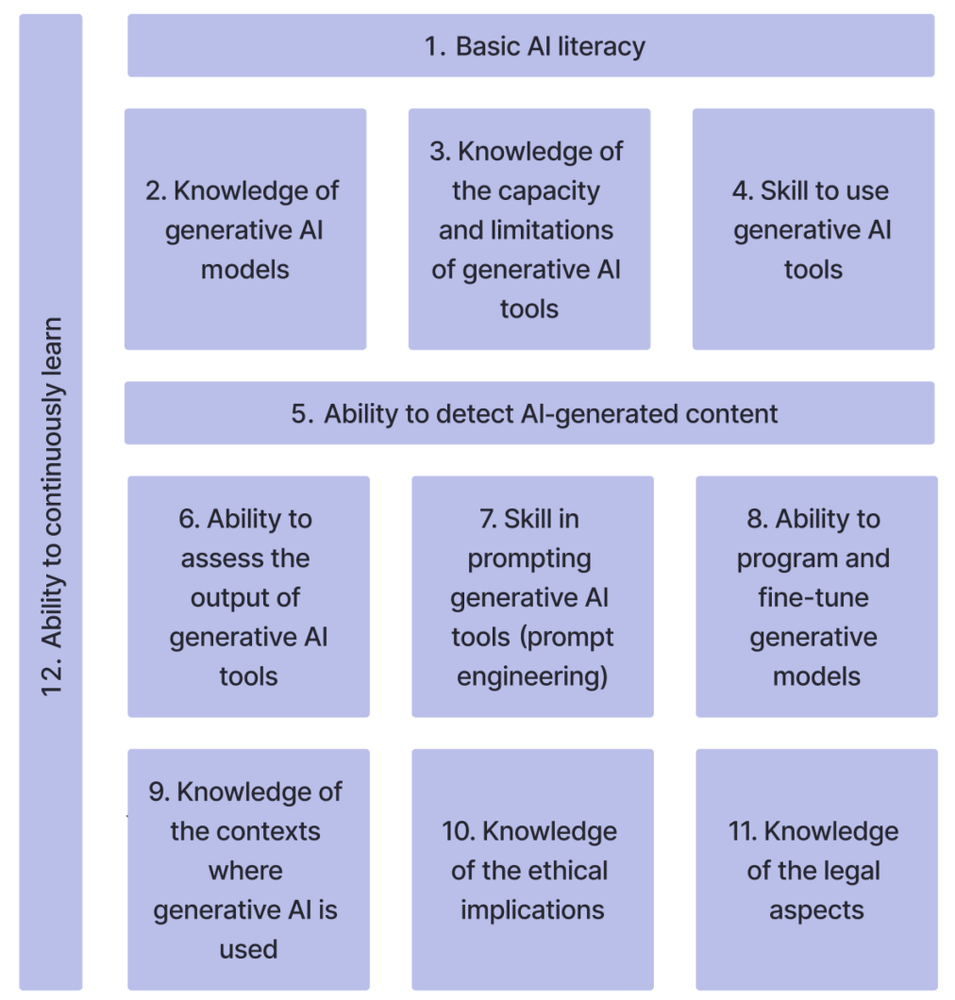
A peer-reviewed study from researchers at École Polytechnique Fédérale de Lausanne identified twelve distinct competencies that define generative AI literacy (Annapureddy et al., 2025). These aren’t arbitrary skills; they’re a systematic framework for learning. This article translates that framework into concrete, actionable steps.
The 12 generative AI competencies (Source: Annapureddy et al. 2025. Generative AI Literacy: Twelve Defining Competencies. Digital Research and Practice, 6(1), 1-21). https://doi.org/101145/3685680
The diagram above shows that these competencies build on each other, moving from foundational understanding (1-4) through critical evaluation (5-6), technical application (7-8), and finally to contextual wisdom (9-12). You don’t need all twelve; your role will determine your focus.
How to use this: Pick the persona that fits you today and follow the 90-day plan. You can always level up later.
Persona 1: The AI Consumer (Non-Technical User)
You are:
A knowledge worker, manager, or creative who will USE AI tools daily.
Your 90-Day Plan:
Weeks 1-2: Foundation: (Read) Spend 3 hours on “AI Literacy” basics—understand what large language models are and why they sometimes “hallucinate.” Watch: “But what is a GPT?” by 3Blue1Brown for a clear 20-minute explanation. Try: Create accounts on ChatGPT and Claude. Spend 30 minutes daily asking both the same questions to see how outputs differ.
Weeks 3-6: Skill Building: (Practice) Dedicate 30 minutes each morning to a specific use case (e.g., Monday: Email drafting, Tuesday: Meeting summarization). Log: Document what worked, what didn’t, and why.
Weeks 7-12: Integration: (Systematize) Identify 3 repetitive tasks in your workflow and create personal prompt templates for them. Evaluate: Always fact-check AI outputs against authoritative sources.
Red Flags to Watch For: Confident-sounding falsehoods. Outdated or time-sensitive information. Bias amplification from training data.
Persona 2: The AI Power User (Semi-Technical)
You are:
An analyst, marketer, or PM who needs deeper AI integration.
Your 90-Day Plan:
Weeks 1-2: Foundation: Complete the Consumer track PLUS understand API basics and identify 3 AI tools with APIs relevant to your industry.
Weeks 3-6: Skill Building: Master advanced prompting techniques (Chain-of-thought, Few-shot learning, Role prompting). Build your first custom GPT (ChatGPT Plus) or an equivalent automated workflow using Zapier or n8n.
Weeks 7-12: Integration: Design an end-to-end AI workflow for one major responsibility. Document ROI by tracking time saved and quality improvements.
Persona 3: The AI Builder (Technical Professional)
You are:
A developer, data scientist, or engineer who will build AI solutions.
Your 90-Day Plan:
Weeks 1-2: Foundation: Learn If new to ML, complete fast.ai‘s “Practical Deep Learning for Coders.” If experienced, dive into the “Attention Is All You Need” paper.
Weeks 7-12: Integration: Develop one production-ready application with evaluation metrics. Learn deployment (Docker, API creation) and contribute to an open-source AI project.
Worth the Investment: API credits, technical books; e.g. “Designing Machine Learning Systems” and “AI engineering” by Chip Huyen.
Persona 4: The AI Strategist (Leadership/Management)
You are:
An executive or team lead deciding on AI adoption and strategy.
Your 90-Day Plan:
Weeks 1-2: Foundation: Understand AI capabilities at a strategic level by using the tools yourself and attending webinars on AI adoption.
Weeks 3-6: Skill Building: Develop an evaluation framework with questions to ask AI vendors. Study case studies of both successful and failed AI implementations in your industry.
Weeks 7-12: Integration: Conduct an AI readiness assessment for your team. Create a governance framework: Who approves tools? What use cases are off-limits? Build a business case with key metrics (time saved, quality improvement, revenue impact etc.).
Executive Education: Free: “AI For Everyone” by Andrew Ng (audit on Coursera), MIT Sloan Management Review articles. Paid: Google Cloud Generative AI Leader Certification , Microsoft AI PM Certificate , workshops from universities.
Getting Started: Your First Steps Today
Feeling overwhelmed? Don’t be. Start here:
Experiment: Spend 15 minutes right now asking ChatGPT, Gemini or Claude a question about your work.
Choose One Resource: Pick one free resource from your persona’s list and subscribe or sign up.
Schedule Learning Time: Block 30 minutes on your calendar twice this week for “AI Skill Building.”
This is a marathon, not a sprint. The key is to start today. Your future self will thank you.
Now, I’d love to hear from you:
Which persona do you identify with most? (Consumer, Power User, Builder, or Strategist?)
What’s one step you’ll take this week to improve your AI literacy?
What are your favorite AI resources that I might have missed?
As Vice President of Data, Analytics, and AI, Dr. Alpha Hamadou Ibrahim contributes to Tambellini’s extensive database of research reports and guides, while also offering clients specialized advice and assessments. He has expertise in data management, cloud migration, analytics, and artificial intelligence (AI). He helps institutions understand how they can leverage the latest analytics and AI technologies to improve organizational efficiency and drive profitability.