
Principal Analyst
Modern cloud administrative solutions, including finance, HCM, and student, have delivered one clear set of outcomes: standardized, configurable processes where customers cannot customize the core application. That’s real progress, based on the critical weakness of legacy on-premises solutions —expensive customization and the need for massively disruptive upgrades.
But it also created a very different data and application ecosystem problem. Many institutions still run system selections using frameworks designed for a very different era, which often leads them to optimize transactional fit at the expense of platform capabilities. They may choose a “best-fit” transactional system and then spend the next five years building parallel stacks to deliver analytics, and make it usable, integrable, and AI-ready.
The buyers who succeed in the next procurement cycle will treat modernization as a platform decision, not solely a transactional system decision. Bringing cross-institutional leaders together under this premise can be very challenging.
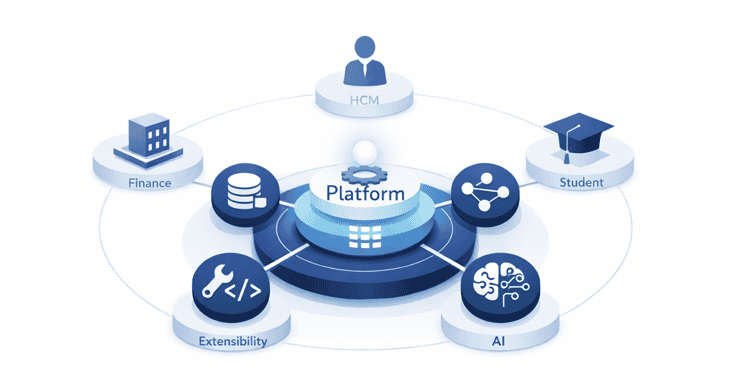
“Platform”, in this context, describes all the capabilities of a software solution (e.g., extensibility, data and analytics, and AI) that can be utilized across the functions that it supports (e.g., finance or HCM).
Software as a Service (SaaS) didn’t simplify institutional data management strategies but instead fragmented them.
Institutions now have operational truth spread across finance, HCM, student, CRM, student success platforms, departmental SaaS, and typically also the Microsoft ecosystem, which continues to expand. Then come the spreadsheets, the one-off data pipelines, the “temporary” exports that become permanent, and the reporting from multiple sources that contradict each other.
This has created a core architectural problem that requires serious attention for these systems to deliver their key analytical outcomes.
If your selection team can’t articulate where the data center of gravity will live, you’re going to recreate the old warehouse wars: duplicated definitions, competing dashboards, uneven controls, and a trust problem that senior leadership will misdiagnose as “analytics isn’t delivering value.” This definition of “center of gravity” may vary by the solutions you review—some have full-blown data management platforms available, and some have varying degrees of data management functionality available.
The platform behind transactional systems increasingly dictates:
If you don’t evaluate this up front, you will likely miss the key outcomes of your modernization efforts: supporting data-driven decisions and streamlining processes outside the traditional core of these solutions (e.g., tuition remediation).
SaaS solutions will not change for you. Configurability has limits, and most institutions are identifying a handful of critical spots where they require deeper extensibility.
Your institution still has edge-case processes, compliance realities, and service models that don’t map cleanly to “best practice” out of the box. That means you will build—somewhere. The question is whether you build in a sanctioned, supportable way or you build in a separate, integrated platform ecosystem.
In SaaS, the extensibility platforms are differentiated by:
This is where most selection processes often fall short. Teams prioritize functional demos and fail to consider how the institution will scale and integrate the solution. Consequently, they go live and realize that “no customization” actually means “all customization has been moved to integration and extensions.”
Extensibility is often sold as a platform layer with separate licensing, requiring distinct skills and operating model decisions. If your RFP and evaluation don’t force clarity on what’s included versus what’s extra, you may end up with unwelcome surprises later in your process.
AI is the dominant investment theme for every major administrative vendor. Some of it is marketing, but a growing amount of it is real. Agentic AI holds real promise to reduce administrative burden, and in 2026, we’ll see some of the first agentic AI implementations at scale.
But the institution’s outcomes will be determined less by what the vendor ships and more by whether you can operationalize it without breaking governance, security, and trust. Many institutions have not yet found their way to effective security, governance, and control mechanisms for adopting AI.
Platforms matter here because they control the rails:
If your selection criteria treat AI as a checklist of copilots, you’re going to buy the story and miss the infrastructure.
Most system selections are structured to answer one question: which application best fits our functional requirements. That framing is now incomplete.
The institution must shift the conversation early in the buying cycle so that the platform is explicitly part of the decision, and platform outcomes are defined as part of the project. Not “we’ll figure out integration later.” Not “analytics is a phase two.” Not “we’ll come back to AI readiness after go-live.”
If platform outcomes aren’t named, scoped, and evaluated, they won’t happen. They’ll become a set of reactive projects, funded inconsistently, built by different teams, and rationalized as “implementation realities.” Consider requirements around data repositories, analytics, AI, integration, and extensibility capabilities as a central component of your evaluation.
If the platform isn’t in the evaluation model, the institution will still pay for it. Having built an approach (architecture)—or at least a set of required capabilities—will help your teams evaluate solutions and platforms more holistically against your needs.
Even if you accept the platform premise, the next problem is market complexity.
The “platform behind ERP” is not a single vendor product. It’s an ecosystem that varies greatly between solution providers: vendor-native tooling, partner marketplaces, third-party integration and data platforms, and now a fast-growing layer of AI agents.
That makes buying and managing the platform materially more complex than it was even five years ago:
Procurement models haven’t caught up. Governance models haven’t caught up. And most selection teams are not staffed or prepared to evaluate an ecosystem, so they default back to what they know: functional requirements lists and demo performance.
That’s the trap.
Enterprise architecture decisions increasingly come down to which contracted enterprise vendor controls which tasks.
Here’s what you should be weaving into the decision process:
These are not technical debates—they are control plane decisions. They determine vendor leverage, long-term cost, portability, and the institution’s ability to change direction later without ripping out half the stack.
If you don’t decide these intentionally, the institution will drift into them. And once you drift, it’s hard to unwind.
Software selection must evolve from a solely module-based competition to a platform-centric decision to meet the institutional strategic needs. It can be a challenge to meaningfully incorporate this set of considerations into a process that is necessarily driven by functional leaders, not just IT. Thus, IT has to explain the platform’s impacts to non-technical users and executives in terms of institutional capabilities, not technical details.
Institutions can leverage the modernization cycle to refine enterprise architecture, define platform outcomes upfront, and make explicit control decisions regarding data, integration, extensibility, and AI agents. The outcome is then a long-term strategy that aligns functionality with a set of technologies that are agile and sustainable, and ultimately, an ecosystem that meets critical data and process needs of your institution: Accessible, trusted data and long-term agility in process definition in an industry that faces continued chaos.
If you don’t do that, you will still modernize. You’ll just modernize into a more expensive version of some of the same problems, with a cleaner interface.
Originally posted by Dave Kieffer on LinkedIn. Be sure to follow him there to catch all his great industry insights.
Share Article:

© Copyright 2026, The Tambellini Group. All Rights Reserved.
Get exclusive access to higher education analysts, rich research, premium publications, and advisory services.