
Tambellini Author
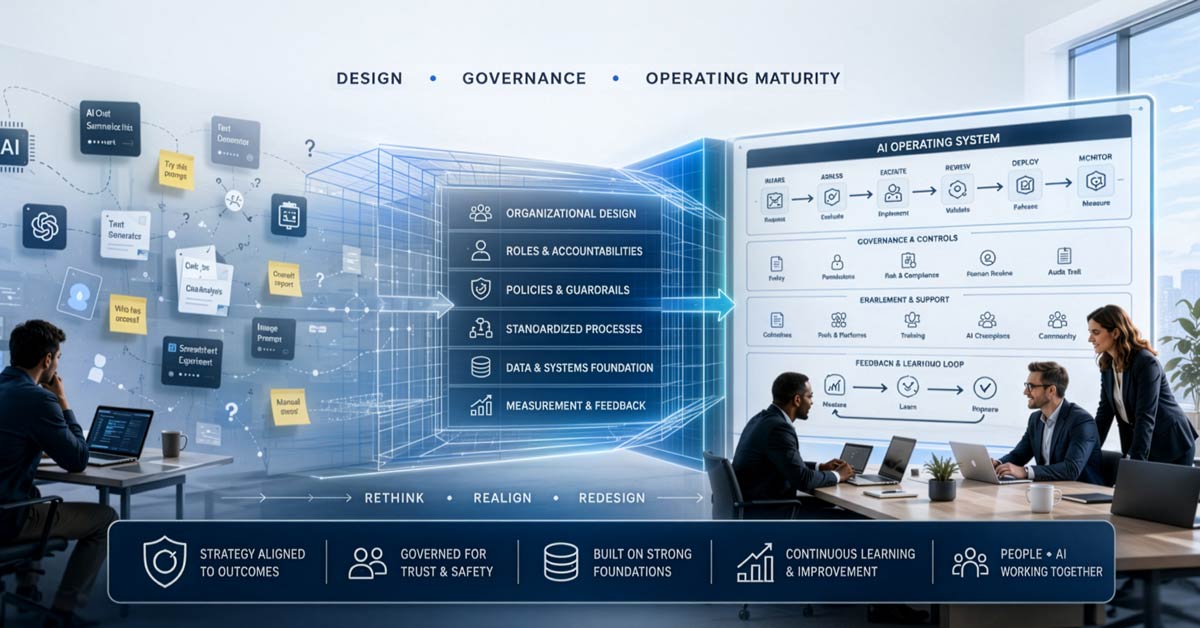
AI adoption is getting weird inside companies. Not slow. Not fast. Uneven.
In one corner of the organization, people are using AI every day: drafting briefs, summarizing calls, cleaning spreadsheets, writing code, and testing ideas. In another corner, people are still waiting for approval to use a basic assistant.
That difference matters. Not because every organization needs to chase every new model. It doesn’t. It matters because AI is starting to expose something deeper: how quickly an organization can learn, coordinate, govern, and redesign work.
Cyberhaven’s 2026 AI Adoption & Risk Report found that the top 1% of early adopter organizations use more than 300 GenAI tools. Cautious enterprises typically use fewer than 15. That is not just a technology gap. It is an operating gap.
The teams moving fastest are not only using more tools. They are building new habits around the work. They are asking better questions:
Those questions sound boring compared with model launches, but they are where the real advantage is forming. The next phase of AI adoption will not be won by the teams with the longest tool list. It will be won by the teams that can turn experimentation into repeatable practice.
That is much harder than giving everyone access to a chatbot. A chatbot can help one person move faster. An AI-enabled organization needs shared norms, clear permissions, training, data governance, and managers who understand how work is changing.
This is where many organizations get stuck. They frame AI adoption as a tools problem:
Those are fair questions. But they are not enough. The better question is: What parts of our work are actually ready to be redesigned?
Because AI does not magically fix a messy workflow. In many cases, it exposes the mess. If the data is scattered, AI will produce confident but incomplete answers. If approvals are informal, automation creates risk. If teams are not trained to evaluate outputs, speed can quietly become rework. And if policy is too restrictive, employees will work around it.
That last part matters.
Blocking AI completely may feel safe, but it often pushes usage into personal accounts, unsanctioned tools, and invisible workflows. Cyberhaven also found that 32.3% of ChatGPT usage in enterprise environments happens through personal accounts. For some tools, the rate exceeds 50%. That usage is invisible to IT, bypasses logging and retention policies, and most organizations are not tracking it.
So the divide is not simply between organizations that “use AI” and organizations that do not. It is between organizations that can create safe learning loops and organizations that cannot.
A safe learning loop is not complicated. Pick a real workflow. Define what good output looks like. Decide what data the tool can access. Test with a small group, measure the result, document what worked, and update policy based on reality rather than fear. Then do it again with the next team. Boring? Maybe.
But that is where the work is. That is how AI moves from novelty to capability. This becomes even more important as AI agents enter the workplace. Agents do not just answer questions. They can take steps, use tools, remember context, and operate across workflows. That makes governance less optional.
OpenAI’s workspace agents, for example, are designed for shared team workflows across tools like ChatGPT and Slack. That is useful. It also raises harder operational questions:
Recent guidance from the US, UK, Canada, Australia, and New Zealand put the issue plainly: agentic AI should not be given broad or unrestricted access, especially to sensitive data or critical systems.
That is not anti-AI. It is basic operational hygiene. And this is where the adoption gap gets sharper. One organization may have employees casually testing agents in disconnected pockets. Another may have a clear system for deciding which agents exist, what they can access, who owns them, how performance is reviewed, and when they should be retired.
Those two organizations are not just using different technology. They are building different muscles.
My take: the organizations that do well with AI in 2026 will not be the loudest adopters. They will be the best learners. They will make room for experimentation without pretending risk does not exist. They will give employees practical guidance instead of vague warnings. They will treat governance as an enabler of adoption, not a brake on it.
And they will stop asking only: Which AI tools should we use?
The better question is: What kind of organization do we need to become so these tools actually improve the work?
That is where the real gap is opening.
Originally posted by Alpha Hamadou Ibrahim on LinkedIn. Be sure to follow him there to catch all his great industry insights.
Share Article:

© Copyright 2026, The Tambellini Group. All Rights Reserved.
Get exclusive access to higher education analysts, rich research, premium publications, and advisory services.