

Principal Analyst
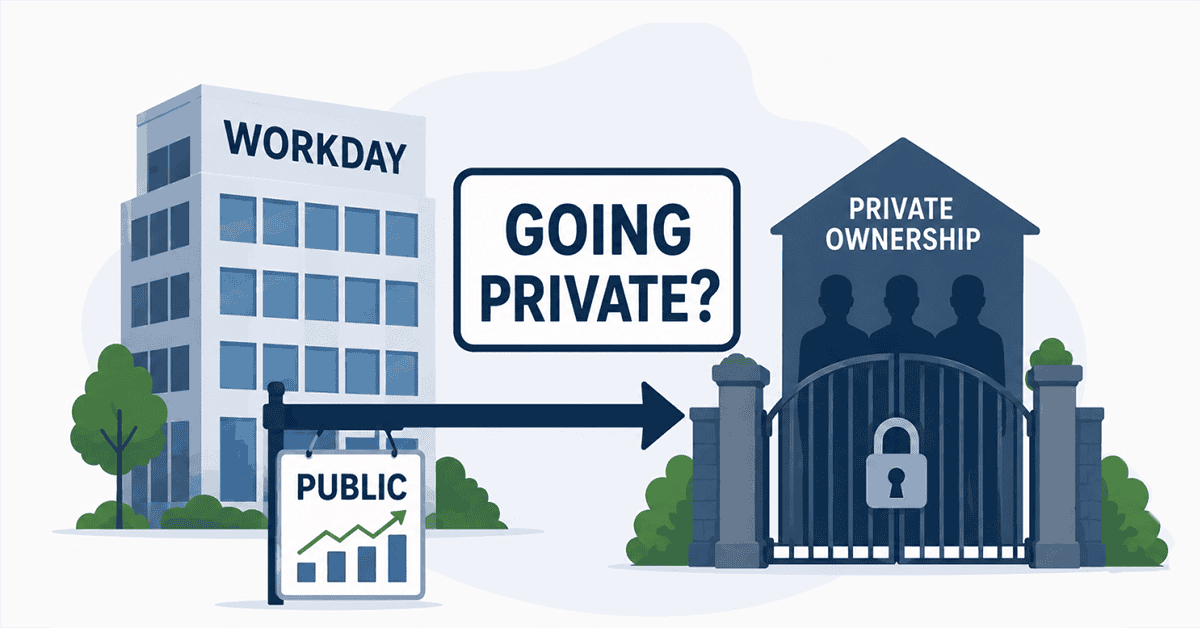
On August 13, Reuters reported that Silver Lake is in talks to take Workday private. Before the report, Workday carried a market value near $43 billion. The stock jumped nearly 18 percent on the news and closed the day with a market value of roughly $51 billion. A deal at that size would rank among the largest software buyouts on record, and it would be the largest take-private I can point to involving a pure enterprise applications vendor. For context, Hg agreed in January to take OneStream private for $6.4 billion, one of the larger software buyouts of the year. A Workday deal would dwarf it.
The possibility of Workday going private has not been confirmed by either company, and the reported talks may never result in a transaction. What grabs my attention is the logic, because it looks more like a deliberate strategic decision than an unsolicited takeover bid.
The defining question in enterprise software right now is capital. Who can fund the repositioning that AI demands, and under whose scrutiny?
Workday’s shares had fallen more than 40 percent from their 2024 peak as investors questioned whether traditional per-seat SaaS holds up in an agentic AI world. Going private would remove the public quarterly earnings cycle, and that is the point. A founder-led team could plan against a multi-year horizon, reset pricing, and rebuild the product around agents without a public shareholder base flinching at every step. That is roughly what Bhusri was describing this spring. The trade-off is real, though. Private equity owners typically apply tighter cost and investment discipline than public markets do, so the pressure does not disappear. It changes shape, from quarterly earnings to debt service and sponsor return targets, and it is applied by people who sit on the board rather than by analysts on a call.
Aneel Bhusri returned as CEO in February with a focus on leading Workday through the AI era. He indicated this spring at an analyst gathering I attended that the share price was not his concern. Maybe the private path was already the plan. He co-founded the company, knows the private capital world well, and a take-private would buy him the runway to rebuild on his own timeline.
Silver Lake fits that job. A deal of this size could involve co-investors, and Silver Lake has built those structures recently. It took Qualtrics private with CPP Investments, and it joined Saudi Arabia’s Public Investment Fund and Affinity Partners to take Electronic Arts private for about $55 billion, completing that transaction earlier this month. The firm reports roughly $114 billion in combined assets under management and committed capital, and it has the relationships to assemble the equity, including a strong relationship with Bhusri.
Workday serves more than 11,500 customers, and its higher education footprint is significant across Workday Human Capital Management, Workday Financial Management, and Workday Student. For an institution, a change of ownership is a transition that requires review.
Start with the roadmap and investment direction because private equity ownership can move in one of two directions. It can concentrate investment on the core platform and the AI roadmap, or it can chase margin and starve the lines that are not yet paying their way. In higher education, the line to watch is Workday Student. It has been a long build, and a restructuring could accelerate it or quietly sideline it. Any institution in an active evaluation should put that question on the table.
Pricing deserves the same scrutiny. Private equity owners tend to optimize pricing, so an institution with an upcoming renewal should model its escalators carefully and understand its leverage now, before an ownership change resets the negotiating posture.
Continuity could signal stability. If Bhusri stays in the seat, it would reassure customers.
None of this is decided. The talks could stall, and Silver Lake could walk. What is already true is that the possibility of Workday going private is now an open question, and open questions belong in a vendor assessment. For an institution running Workday or considering it, I would treat this as a live consideration alongside product fit and cost. A vendor’s financial position and strategic direction should always be taken into account during product selection, negotiation, and renewal.
What it likely does not mean is that Workday is in trouble. From my point of view, this looks like a strategic move to enable Aneel’s vision, not a move by a private equity firm to bleed revenue from a decaying company.
Originally posted by Dave Kieffer on LinkedIn. Be sure to follow him there to catch all his great industry insights.
Share Article:

© Copyright 2026, The Tambellini Group. All Rights Reserved.
Get exclusive access to higher education analysts, rich research, premium publications, and advisory services.