

Tambellini Author
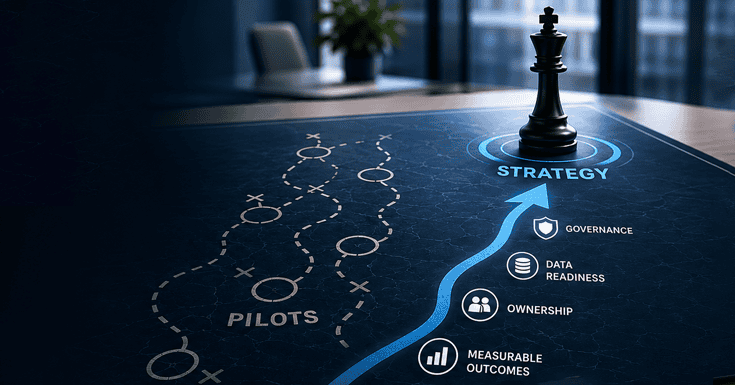
AI pilots are not an AI strategy, but for a lot of organizations, the pilot has become the default first move. And that’s fine as a starting point. Pilots let teams test an idea, see what the technology actually does, find where the workflow breaks, and get comfortable with it.
The trouble starts when the pilot quietly becomes the plan. A pilot can tell you whether AI can do a task. What it can’t tell you is whether your organization is ready to change how the work gets done. That second question is the one that actually decides things.
Most places I talk to are running several experiments at once: a productivity assistant here, document summarization there, some service automation, coding tools, etc. Any one of them is reasonable. Line them all up, though, and a different problem shows up. There’s plenty of activity and no direction.
A list of pilots isn’t a strategy. A strategy is a set of decisions about where AI should create value, how it gets governed, what data it can lean on, who’s on the hook for the result, and how you decide what’s worth scaling. That takes more than enthusiasm. It takes operating discipline, which is the less exciting part and usually the part that gets skipped.
A few things have to be true before scaling makes any sense.
The instinct is to ask, “Where can we use AI?” Ask that and you’ll have a list by lunch. The more useful question is narrower and a little more uncomfortable: Which outcomes matter enough that we’d redesign work around them?
Tie AI to something the organization already cares about, like faster cycle times, better service, or less risk, and the work has a reason to exist. Skip that step and the pilots drift. They stay interesting, and nobody can quite say why they’d fund one over the next.
Governance usually gets cast as the brake on innovation. In practice, it’s what lets you move past the experiment without holding your breath.
Once AI starts touching real processes, you need clear answers on acceptable use, data access, vendor risk, and human oversight. Not every use case needs the same scrutiny. A tool that drafts meeting notes isn’t in the same league as one shaping a financial decision, so the job is to sort the risk early and match the oversight to it.
Get it wrong and you end up in one of two bad spots: people doing whatever they like, or people too nervous to do anything at all.
Here’s the one that quietly sinks more projects than any model limitation: your AI strategy is only as good as your data.
Pilots tend to work because someone curated the data and kept the scope small. Real life isn’t curated. At scale, AI agents run into messy systems, inconsistent definitions, permissions, and records nobody’s touched since 2019.
That’s usually the moment teams realize the model was never the hard part. The hard part is knowing which data they can trust, who owns it, and whether it’s good enough for the decision riding on it. AI won’t paper over data you don’t understand. It’ll just automate the confusion faster.
AI isn’t only a tech rollout; it changes the work, so no single function can own it alone. The business owns the outcome. Technology owns the architecture and integration. The data people own quality and access. Legal, security, and risk set the guardrails. And the people doing the actual job have to shape how the workflow changes, because they’re the ones who’ll have to live with it.
Leave any of those vague and AI becomes everyone’s pet project and nobody’s responsibility.
It’s easy to count the wrong things: pilots launched, tools tried, licenses bought, teams “experimenting.” That’s motion.
Value is whether the work actually moved something: time saved, quality up, risk down, or a decision made faster and with better information. The harder discipline is being willing to kill the pilots that don’t, because a strategy built to scale everything isn’t a strategy. It’s a wish list with a budget.
None of this is an argument against pilots. It’s an argument for connecting them to something: deciding how ideas get chosen, how risk gets checked, how you’ll know it worked, how people get trained, and how a scaled solution stays supported once the novelty wears off.
That’s the whole difference between experimenting and building a capability.
Pilots tell you something might work. Strategy tells you whether you can make it work again, safely, without heroics. The organizations that get this right tend not to be the ones with the most experiments running. They’re the ones willing to make a few clear calls and actually build the foundations underneath them.
Pilots are useful. They’re just not a strategy.
What is the biggest gap you’re seeing between AI pilots and real AI strategy: governance, data readiness, ownership, or measurable outcomes?
Originally posted by Alpha Hamadou Ibrahim on LinkedIn. Be sure to follow him there to catch all his great industry insights.
Share Article:

© Copyright 2026, The Tambellini Group. All Rights Reserved.
Get exclusive access to higher education analysts, rich research, premium publications, and advisory services.