

Principal Analyst
Principal Analyst
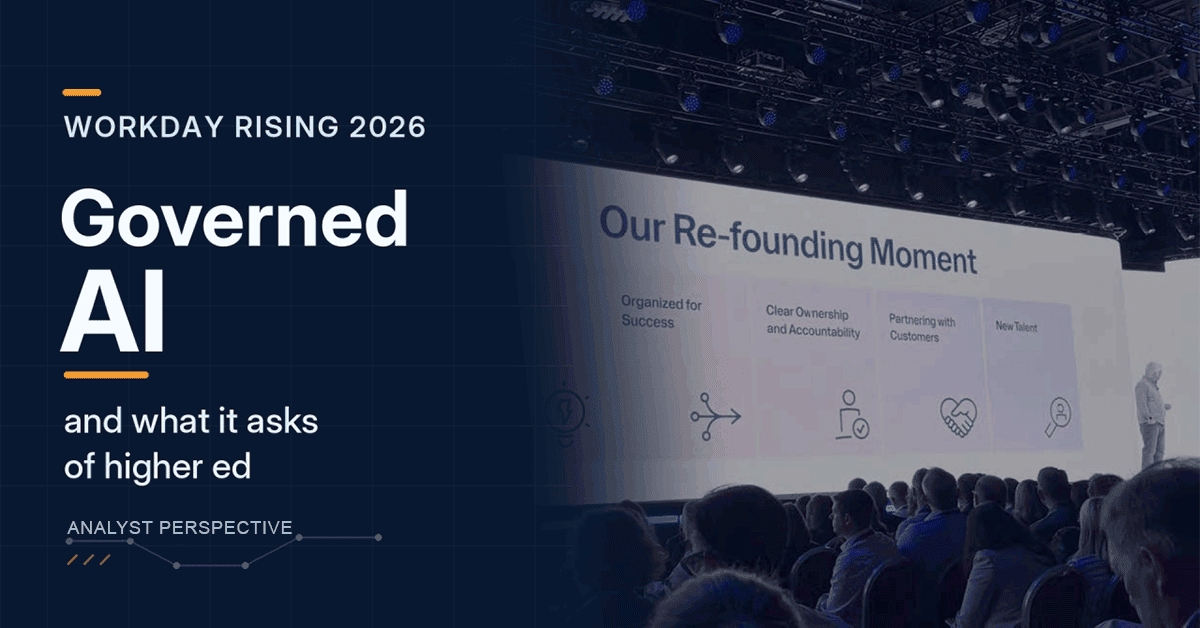
Aneel Bhusri opened Workday Rising 2026 by calling it Workday’s “refounding moment.” Nine months after returning as CEO, he wants a company with more than 11,000 customers to act like a startup. The keynote made the case with live product and 17 agents Workday says are already in production.
The strategy holds together. Workday is betting that AI earns trust in HR, finance, and student systems only when it runs inside the rules those systems already enforce, and it has opened its platform further than we expected.
Our worry is the customers who have to absorb it all. Releases have far outrun what most organizations, especially colleges and universities, can adopt or afford. Real adoption means rethinking processes, skills, and staffing. That’s a big ask, with a big payoff for those who get there.
Below are our higher education takeaways and the two concerns customers raised most: flex credit costs and whether agents are crowding out the core.
Workday’s central argument was that enterprise AI must be “lawful.” As Bhusri put it, you can’t run payroll or close the books on probabilities. Gerrit Kazmaier, president of product and technology, made it his first conviction: agents work within business rules, security roles, and approval chains, and every action is traceable.
The openness surprised us more. Workday Data Cloud now offers zero-copy federation with Snowflake, Databricks, Salesforce, and others, plus live SQL access that honors Workday security. More than 400 MCP tools let outside agents use Workday data, and Sana, the new Workday front door, runs inside Claude, Slack, Teams, and Copilot. For most customers, that openness is a bigger practical win than any single agent.
Two caveats for institutions. The rails protect only work that stays on them; data or reasoning taken outside Workday falls under your own governance. And campus identity is messier than corporate identity, with students, affiliates, and people holding several roles at once. We want to see how C1.ai, the identity governance company Workday plans to acquire, handles that before calling it a campus IAM answer.
Workday‘s front door can default to the Sana chat interface for customers as of this week, and customers can choose Anthropic’s Claude as their primary interface as well. Self-service agents are likely to be the primary interfaces for casual users, and with the capabilities of Sana, we may see advanced users also opt to chat interfaces as well. This seems almost a silly concept a couple of years ago, but now looks to be so fully capable as to be superior interfaces for most users, with customized actions and responses that follow enterprise rules.
We told Workday’s AI platform team we estimate that fewer than 10% of customers, and fewer than 5% in higher education, have the governance, funding, and data foundations to use these agents today. Nobody disputed it. Ethan Mollick set the tone in his keynote by admitting that no one, himself included, really knows where AI is heading. That’s a frightening prospect.
Bhusri’s answer is patience. Citing Geoffrey Moore’s Crossing the Chasm, he put mainstream adoption at least two to three years out and named three “canary” agents he’s watching: self-service, developer, and deployment. He is much more patient than his sales organization.
Workday prices AI in flex credits, which Kazmaier called a logical unit of work, like a batch of analyzed documents or a completed workflow. Workday picks the cheapest model that meets each task’s accuracy target, which he argued shields customers from token economics.
Customers aren’t sold. One attendee asked how to avoid the $1 million overnight token bills seen elsewhere. Dave compared flex credits to 1980s mainframe chargeback, when finance had to decide which department paid for each unit of compute. John Bruce of OneDigital countered on the customer panel, telling the room to “calm down” because outcome pricing is far easier to forecast than a token bill.
Workday is adding controls, including usage estimates, alerts by agent or organization, and hard caps expected around January. For institutions with flat budgets, Bhusri’s advice holds: fund one or two use cases with a clear return, then expand.
Several customers read the agent-heavy keynotes as a sign that HR, finance, and student functionality had slipped. Mike Hofherr, who leads Workday’s higher education business, raised the question himself at the student session: with all this talk of AI, what is Workday doing in the core product?
The worry has some basis. Workday consolidated product under Chief Product Officer Max Wessel, reduced and reassigned staff, and shifted talent toward agent tools. Bhusri admitted the company had lost focus for a while.
Our conversation with Wessel put the reorganization in a clearer light. He described fewer management layers, product and development teams aligned on the same work, and executives much closer to it. He proved the point by leading the detailed agentic finance session himself, down to the feature level. That’s impressive one year in.
The announcements back him up. The student release slide listed nearly 40 items, including One Big Beautiful Bill Act requirements, Parent PLUS changes, and waitlist and program of study updates. HCM added mass job changes and no-cost income and employment verification. Finance added Cost and Profitability Management and Workday Travel inside Expense. AI-built localization now lets Workday stand up a new country’s payroll in days.
Workday argues the two investments reinforce each other. “The stronger the core, the better the AI,” Hofherr said, and every agent we saw ran on Workday’s business processes, security, and data model. Core applications stay on a twice-yearly release cadence, while AI skills ship continuously, and AI-generated code is speeding core delivery too. One engineer cleared about six weeks of tickets over a weekend.
Our read: the core still gets real investment, and the bigger risk is attention. Institutions shouldn’t have to dig through breakouts for the release notes that affect them. Ask your account team for the core roadmap in writing, and Workday should give it more stage time next year.
The most immediately useful higher education news was operational. The Student Administration Agent now handles transcript processing, transfer credit, student holds, and student data insights, and Workday said early adopters cut transcript and transfer credit processing roughly in half. The skills are in early access now, with general availability in 2027 R1. That fits Workday’s research: 54% of student administrators call manual data assembly their biggest burden.
The bigger leap is for students. Workday announced a student agent, its first agent built for students rather than staff. Kate Russell, Workday’s head of industry strategy, cited new Workday research showing that students already ask ChatGPT and Claude about their degree programs, courses, and careers. Those tools don’t know an institution’s section offerings, a student’s aid package, or how transfer credit applies. The student agent does. In the demo, a student asked Sana whether adding a new AI certificate would delay graduation. Sana applied transfer credits the registrar had just processed with the Student Administration Agent, swapped in certificate courses, confirmed that graduation, tuition, and aid were unaffected, and routed the revised plan to the student’s advisor.
This is the most significant advance in the student experience we saw at Workday Rising. The obstacle for students often isn’t academic requirements, Russell said, but “structural barriers”: finding information, finding the right office, and getting plans reviewed and signed off. A general-purpose chatbot can’t clear those barriers. An agent grounded in the student record and institutional policy can, with the advisor still in the loop, and that puts Workday in direct competition with the portal and advising platforms many institutions have layered onto their student systems. Workday gave no release date, though, and the agent isn’t among the 2027 R1 items it showed, so treat it as direction rather than a planning assumption.
Financial aid got attention too. Workday formed a Financial Aid Product Advisory Council, is building a tool to track federal aid guidance, and will add LightLeap AI fraud screening to admissions in 2027 R1. LightLeap is also coming to Ellucian, so fraud screening is becoming a baseline expectation for any student system. On grants, an award contract agent is in development.
Two more announcements may matter just as much over time. Data Cloud will include student data starting in 2027 R1, so institutions can join student, HR, finance, and grants data without building a warehouse first, putting program costing and enrollment planning within reach. Workday is also testing AI-accelerated Workday Student deployments aimed at cutting deployment time by an order of magnitude. If that holds, it changes the math for smaller institutions that have found Workday too expensive to implement.
If you’re live on Workday, start with the agent closest to a problem you already feel, such as student administration, self-service, or AP. Put a value estimate on it before signing a flex credit agreement, turn on monitoring from day one, and get the core roadmap for your modules alongside the AI roadmap.
If you’re selecting or implementing, plan for the product you’ll go live on. With go-live 18 to 24 months out, Sana will be the default experience and many of today’s early access agents will be generally available. Design around outcomes, and build agent governance and an identity strategy into the project now, while those decisions are still cheap.
In nine months, Workday has moved its entire organization into startup mode. The restart bets the company on a renewed vision of what a SaaS company should be, with AI in every part of its products and its own operations. Our first look leaves us cautiously optimistic.
Originally posted by Dave Kieffer on LinkedIn. Be sure to follow him there to catch all his great industry insights.
Share Article:


© Copyright 2026, The Tambellini Group. All Rights Reserved.
Get exclusive access to higher education analysts, rich research, premium publications, and advisory services.

