
Tambellini Author
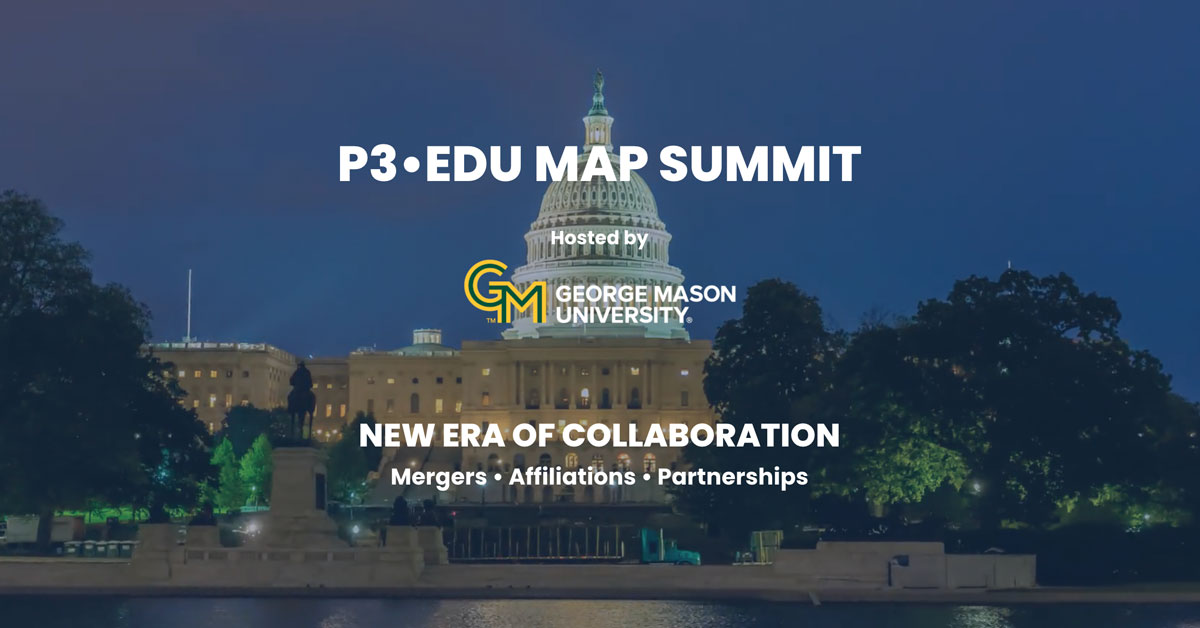
The P3•EDU MAP Summit, P3•EDU’s first standalone event focused on mergers, affiliations, and partnerships, captured a higher education market that is rethinking how institutions build scale, resilience, and capacity. Held March 16 and 17 in Arlington, Virginia, the summit brought together college and university leaders alongside thought leaders from government, associations, foundations, and corporations to explore how institutions can work together to remain viable, protect the mission of higher education, and create new forms of capacity.
Fittingly, much of the program took place at Fuse at Mason Square, a George Mason University site built around a public-private partnership and positioned as a hub for industry, research, and innovation.
The opening plenary, “The New Era of Collaboration in Higher Education,” gave the summit its central frame. The session brought together Tony Allen, President of Delaware State University; Susan Burns, President of the University of Mount Saint Vincent; Daniel Greenstein, Chief of Industry Transformation at Ellucian and Chancellor Emeritus of Pennsylvania’s State System of Higher Education; and Marjorie Hass, President of the Council of Independent Colleges.
Hass emphasized that institutions do not need to move directly to full mergers to collaborate in meaningful ways. Burns pointed to the University of Mount Saint Vincent’s partnership portfolio, including the Catholic Higher Education Alliance, as evidence that institutions can build resilience through deliberate networks. Greenstein stressed that scaling these efforts successfully requires strong governance. Allen brought the point into practice by discussing Delaware State University’s acquisition of Wesley College and its impact on the local economy.
Taken together, the plenary argued that collaboration is not about surrendering institutional identity. It is about building collective resilience in a market that is becoming less forgiving.
Institutional collaboration is expanding into a broader set of options that can create more durable value. A full merger is one path, but institutions are also exploring academic affiliations, shared services, outsourced operations, and public-private arrangements to extend reach, strengthen capacity, and reduce cost. The conference agenda reflected that broader view, with sessions on national and regional affiliation models, strategic MAP approaches, outsourced shared services, shared services partnerships, and MAP integration challenges.
This broader portfolio of options is gaining traction because institutions are confronting a set of deeply interconnected pressures that are harder to solve in isolation. When enrollment declines, revenue pressure follows. As budgets tighten, institutions delay investments, stretch leadership capacity, and become more operationally fragile. When operational strain increases, the institution’s value proposition becomes harder to defend to students and families.
Attendees also pointed to external and structural forces that are making collaboration more necessary and more difficult at the same time, including compliance burden, shifting federal expectations, leadership complexity, politicized accreditation debates, and concern that new accreditors could align with ideological preferences. Even in that environment, the conversation kept returning to the same priorities: mission-driven decision-making, leadership development, and stronger operating discipline. Tony Allen, president of Delaware State University, urged attendees to focus on practical solutions already in plain view. In his framing, addressing enrollment decline begins with strengthening talent pipelines, building capacity in K-12, and meeting students where they are.
“The Future of MAP Models” panel moved the conversation from diagnosis to execution. Speakers examined recent merger and closure trends and emphasized the conditions that make partnerships work: strategic alignment, cultural fit, financial viability, and operational efficiency. The panel also addressed AI’s impact on the job market, the need for clear communication, and the importance of long-term planning.
For institutions, that means planning beyond the deal itself and accounting for people, processes, data, technology, governance, and mission from the outset. Without that discipline, even a well-conceived partnership can break down in execution.
As institutions consider how to effectively implement collaborative models, they should define exactly what problem a partnership is meant to solve before they evaluate partners. Is the goal scale, program breadth, geographic reach, talent pipeline development, financial stabilization, shared services efficiency, or some combination of those?
Leadership teams should assess their integration readiness now. That means identifying where governance, business processes, data, systems, contracts, and decision rights would break if the institution had to work across another organization. This is an immediate priority if institutions want to be prepared to take advantage of future collaborative opportunities.
Finally, both institutions and vendors need to plan for durability beyond any specific transaction. Institutions should define what success looks like in five, ten, and twenty years. Vendors should be prepared to explain how their products, contracts, services, and support models hold up through organizational change, leadership turnover, and integration work.
Institutional leaders should be asking these questions now:
If we entered a merger, affiliation, or shared-services arrangement in the next twelve months, where would our institution be least prepared, and how can we build greater agility in those areas? Examples may include governance, academic operations, finance, technology, and stakeholder communication.
Which current vendor relationships would accelerate that transition, which would slow it down, and how can we work with those vendors now to reduce friction, clarify expectations, and improve readiness?
The biggest takeaway from P3•EDU MAP was not that more institutions are talking about mergers. It was that leaders are broadening the portfolio of options available to them, using mergers, affiliations, shared services, and public-private models more strategically to support institutional goals. These collaborative models are no longer viewed as a last resort. They are increasingly being treated as deliberate, mission-aligned strategies to build capacity, extend reach, and strengthen long-term sustainability. For institutions and the vendors that serve them, the message is clear: the value now lies not just in recognizing these options, but in knowing when to use them, how to structure them, and how to execute them well.
Share Article:

© Copyright 2026, The Tambellini Group. All Rights Reserved.
Get exclusive access to higher education analysts, rich research, premium publications, and advisory services.