

Resilience is often treated as a response to disruption. The 2026 Future Campus™ Summit made a stronger case: institutions must build the capacity to align, decide, and adapt into everyday operations before the next disruption arrives.
From August 4 to 6, Tambellini Group convened higher education leaders, technology executives, analysts, and advisors in New York City for Resilience by Design: With AI, Data, and Engagement. The event brought together nearly 100 higher education executives from 71 institutions across 26 states and Washington, D.C., along with 44 technology partner executives.
Technology partners participating in the Summit included Ellucian, Google Cloud, Qualtrics, Adobe, Drivestream, HPE, Instructure, Oracle, Socure, Workday, Alteryx, Cisco, ERPA, Fischer Identity, Pathify, Stellic, Strata, and Kissflow.
Institutional executives need dedicated space to speak candidly with technology-partner executives, compare approaches, evaluate assumptions, and explore potential solutions outside formal presentations and procurement discussions. The Summit provided that space through executive one-on-one meetings, interactive sessions, and informal conversations, enabling institutional leaders to ask specific questions, discuss challenges, and build relationships with partners aligned with their institutional goals.

The Summit centered on the operational priorities that sustain institutional momentum: student success, decision confidence, fiscal health, and campus efficiency. Sessions addressed institutional redesign, cybersecurity, retention, technical debt, AI literacy, workforce readiness, agentic AI, and the human impact of technology adoption. Across formal sessions, executive discussions, and informal exchanges, the conversation repeatedly returned to the institutional choices required to turn emerging technology into measurable progress while preserving trust, human judgment, and mission. Six takeaways stood out.
Tambellini’s Future Campus™ Framework examines institutional challenges through four connected perspectives: people, process, data, and technology. Resilience depends on all four moving together.
New technology platforms and AI pilots cannot compensate for broken processes, weak governance, or misaligned priorities. Leaders across academic affairs, student success, finance, operations, enrollment, human resources, and IT must agree on outcomes, ownership, decision rights, and measures of progress.
As Tambellini Principal Analyst Dave Kieffer explained: “Saying, ‘We’re going to change or introduce a technology,’ doesn’t move anyone. You need to lead with a clear vision. You need to know where you’re going, and you need to know why you’re going there, to draw people into it.” Resilience begins with that shift, from treating technology implementation as the objective to rallying the institution around a shared purpose.
Tambellini Analyst Nipuna Ambanpola captured a similar and recurring idea: “AI is not a destination, it’s a practice.” Institutions build sound judgment through controlled experimentation, clear governance, practical use cases, and disciplined learning, including from projects that fall short.
Russ Pearlman, Chief Information Officer at Dallas College, reframed the challenge as a portfolio problem, not an AI strategy problem. Every solution adds contracts, security controls, integration, operating procedures, support, and training. A stronger approach begins by defining the institutional outcomes that matter, establishing measures of success, investing in the strongest use cases, and ending initiatives when the results no longer justify continued investment. The payoff is fewer disconnected pilots and more capacity focused on priorities.
Many institutions identify student risk only after the most effective window for intervention has closed. Academic, financial, and engagement signals often live in separate systems and offices. On their own, each may appear unremarkable; viewed together, they can reveal that a student is beginning to disengage. Tambellini Senior Analyst Novita Rogers, Ellucian Chief Strategy and Corporate Development Officer Jeff Dinski, and Ellucian Chief Product and Technology Officer Michael Wulff discussed how connected data and responsible AI can help advisors, faculty, and staff recognize these patterns earlier and provide more timely, personalized support.
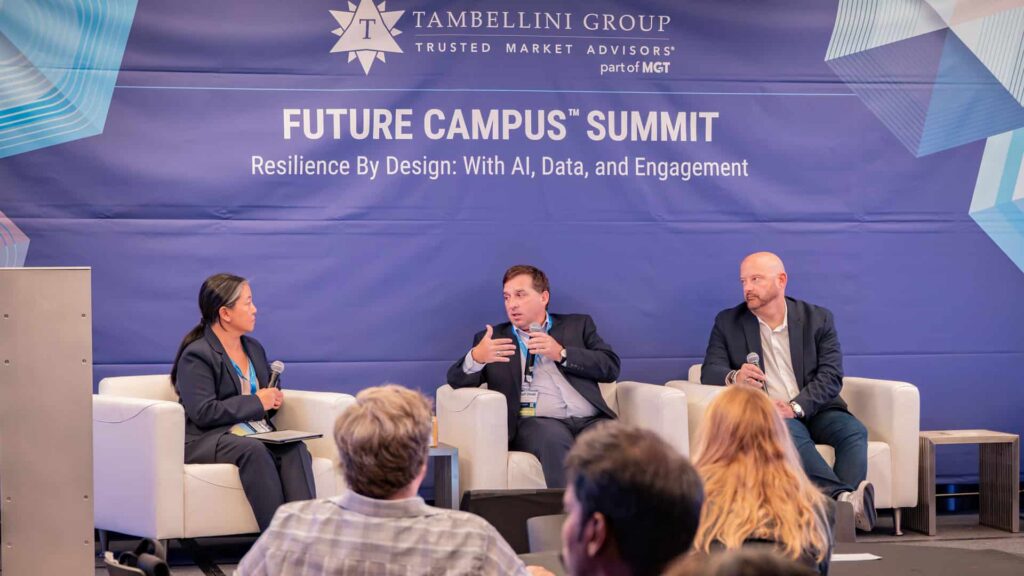
That same principle carried into another session, where the discussion expanded beyond structured operational data. Much of what students communicate about their experiences appears in chat logs, call transcripts, emails, and other unstructured data sources. Katie Johnson, Vice President of Higher Education Strategy at Qualtrics, joined Matt Winn, Tambellini Principal Analyst, to examine a central challenge: institutions rarely lack data; instead, they lack the ability to connect it, develop a trusted, holistic understanding of the student experience, and act in time for intervention to make a difference.
“An insight has little value if it stays in a dashboard. What matters is getting the right information to the right person in time to help an individual student and using what is learned to improve the systems that support all students,” said Matt Winn.
Charles Elliott, Senior Research Engineering Lead for Google Public Sector, joined Alpha Hamadou Ibrahim, Tambellini Vice President of Data, Analytics, and AI, for a fireside chat about what institutions need to move from AI experimentation to sustained value. Their discussion framed agentic AI as an institutional capacity challenge, not simply another technology to adopt. Colleges and universities need scalable, multi-tiered infrastructure, reliable data, security and cost guardrails, and the ability to match each task with the appropriate model. They also need AI fluency across the institution, not only within computer science programs or technology teams.
Faculty, staff, students, and leaders must be able to use AI effectively, evaluate its outputs, understand its limitations, and recognize where human expertise remains essential. Building the technical foundation and these human capabilities together can help institutions accelerate research, modernize operations, personalize learning, and prepare students for an AI-enabled workforce.
North Carolina Central University, Tambellini’s Future Campus Award™ winner for the Teaching and Learning category, demonstrated an institution-wide AI literacy model through its Institute for Artificial Intelligence and Emerging Research. The initiative connects AI literacy, faculty development, research, student leadership, industry partnerships, and career readiness.
As the institute’s founding Director, Siobahn Grady, emphasized, “It has been an honor to help lead this work, but our mission is far from complete. We remain committed to ensuring that every learner has the opportunity not only to use AI, but to understand it, question it, and help shape its future responsibly.”
AI’s value extends beyond faster processing. It can reduce administrative friction and free people to devote more time to mentoring, relationship-building, problem-solving, and meaningful student support. As Nicholas Thompson, CEO of the Atlantic, emphasized in his opening keynote, “Hold onto what’s human.” He urged institutions to identify and preserve the distinctly human work that machines cannot replicate.
Reflecting on her key takeaway from the Summit, Andrea Gibson, Director of Alumni and Community Relations and Development Officer at Tiffin University, reinforced Thompson’s message: “For all the conversations about technology, data and the future campus, I left even more convinced that relationships, belonging and connection will continue to be among higher education’s greatest strengths.”
Higher education’s most complex challenges cannot be solved in isolation. Brandon Toliver, Special Assistant to the President at Tuskegee University, came to the Summit seeking “new partners, stronger relationships, and bold ideas,” and emphasized that: “Challenges to student success in higher education are too complex for any institution to solve alone. Resilient campuses will be built through collaboration, data-informed decisions, responsible use of AI, and leaders willing to share what works. Tambellini has intentionally brought together higher education leaders, analysts, advisors, and industry partners to create the kind of conversations that lead to action, not just discussion.”
That exchange between stakeholders across higher education sectors continued outside formal sessions. Tambellini Senior Analyst Novita Rogers highlighted candid peer conversations, including Women in Higher Education dinners where leaders shared experiences, lessons, and practical wisdom. Trusted communities help institutions benchmark approaches, test assumptions, avoid repeating mistakes, and find peers facing similar challenges.
As Toliver put it, “Every conference should produce more than notes. It should produce relationships, opportunities, and a clearer path forward.”

At the Summit, Tambellini announced the 2026 Future Campus Award™ recipients, who demonstrated how institutions can move AI and data beyond experimentation to solve consequential problems with measurable results.
The common denominator was not the technology alone. Each institution began with a pressing institutional challenge, grounded its use of AI in reliable, relevant data, and delivered clear, measurable impact.
The strongest message from the Summit was not that higher education needs more AI. It was that institutions need to decide where AI belongs through an inclusive, cross-functional process that incorporates the perspectives of those who will govern, implement, use, and be affected by it. Those decisions must be supported by strong foundations, disciplined governance that measures impact, and human-centered operating models that turn insight into action.
“Resilience is not about preserving the status quo. It is about strengthening institutional foundations, redesigning work around outcomes, and using AI to expand human capacity while keeping discernment, empathy, relationships, and mission at the center,” said Hampton Shive, Tambellini Senior Vice President.
The Summit translated resilience into a practical agenda. Institutions should focus on a small portfolio of outcome-driven initiatives, with clear ownership, measures of success, and criteria for deciding whether to stop or scale each one. They should also connect student signals early enough to act, treat technical debt as a strategic risk, and build AI fluency across the institution. Together, these moves help institutions make better decisions, adapt faster, and deliver measurable progress for students.
Tambellini will continue the conversation in the weeks ahead, sharing additional insights, perspectives, and lessons from the 2026 Future Campus™ Summit.
To explore how your institution can put these priorities into practice, learn more about Tambellini Services.