
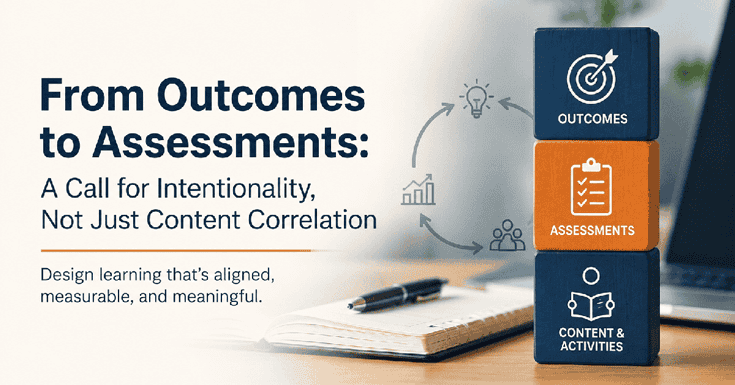
As I wrap up my tour of the major LMS provider conferences, including Blackboard, Canvas, and Brightspace, I find myself returning to a deceptively simple observation: too many courses are still designed around content rather than around learning.
That is not a criticism of faculty commitment. As a former K-12 teacher, professor of education, and dean of online education, and now as a principal analyst, I have seen faculty work extraordinarily hard to support their students. I have also seen how easily course design can pull us toward the wrong starting point. We begin with the textbook. We organize a sequence of chapters. We build lectures, choose readings, create activities, and then add assessments. Outcomes may be present, often because an institution, department, accreditor, or course template requires them, but they are not always the organizing force behind the course.
The result can be a course that contains strong content but lacks a clear line of sight between what students are expected to learn, how they will demonstrate that learning, and how the course will help them get there.
We should begin with learner-centered outcomes: What should students be able to do as a result of completing this course? The wording matters. Outcomes must describe learning that can be observed and measured. An outcome that begins and ends with “understand” does not yet tell us what evidence of understanding would look like. Will students explain a concept? Apply it in a new context? Analyze a case? Evaluate competing claims? Design or create something? The outcome should make the expected performance visible.
Once those outcomes are clear, the next question is not, “What content should I cover?” It is, “What evidence would convince me that students have achieved the outcome?”
That is where assessment belongs, not at the end of the design process, but near the beginning. Assessments are the means through which learning becomes observable. They allow students to demonstrate what they know and can do, and they allow faculty to determine whether the intended learning has occurred. If an outcome is important enough to include in a course, students should have a meaningful opportunity to demonstrate it.
Only after we have established the outcomes and identified the evidence should we design the content, lectures, discussions, practice opportunities, and learning activities that will help students move from where they are to where the assessment asks them to be.
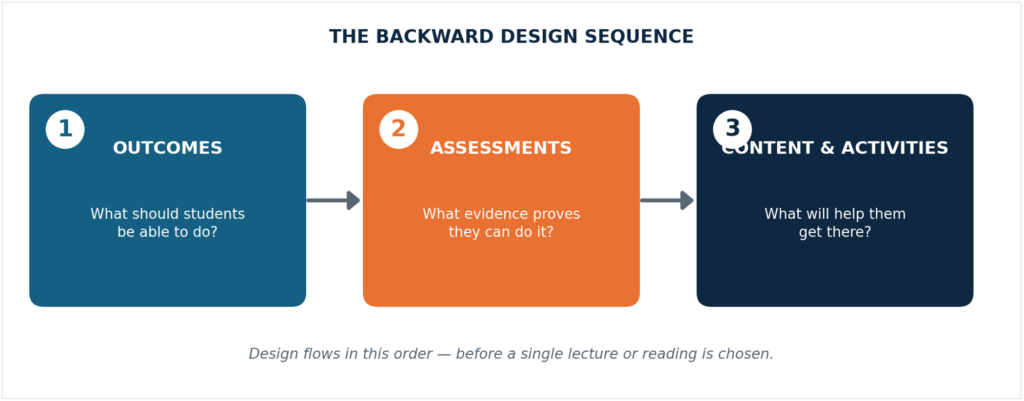
This is the essence of intentional course design. Content and faculty expertise still matter deeply. So do readings, lectures, demonstrations, discussions, simulations, and practice. But these elements should not exist simply because they have always been part of the course, appear in the textbook, or interest the instructor. They should have a clear purpose in supporting student progress toward the stated outcomes and the assessments that measure them.
Too often, however, outcomes sit beside the course rather than within it. They appear on the syllabus or in an LMS module, but they do not meaningfully influence the sequence of instruction. Faculty may inherit outcomes they did not write or be asked to map outcomes after the course has already been built. Time constraints may reward getting content online rather than stepping back to examine alignment. In some cases, assessment becomes an afterthought: a test created because the module is complete, not because it is the best way to observe the intended learning.
That can produce a disjointed experience for students. They may be asked to read and listen at one level, practice at another, and perform on an assessment at a third. Faculty may believe they have “covered” an outcome because the topic appeared in a lecture, even though students were never asked to demonstrate it meaningfully.
A course can contain content related to an outcome without giving students the support or opportunity needed to achieve it. A lecture can mention critical thinking without requiring students to think critically. A reading can describe a professional practice without asking students to perform that practice. A quiz can include vocabulary from a unit without measuring whether students can use the concepts in context.
| Coverage says… | Alignment requires… |
|---|---|
| A lecture mentions critical thinking | Students are required to think critically |
| A reading describes a professional practice | Students perform that practice |
| A quiz reuses vocabulary from a unit | Students use the concepts in context |
| The topic appeared, so it was “covered” | Students had a real chance to demonstrate it |
This is where Bloom’s taxonomy remains useful. It should not be treated as a compliance exercise or a list of verbs to insert into a template, but as a way to think about the level of cognitive work we are asking students to perform.
Outcomes should be written across appropriate levels of Bloom’s taxonomy. Foundational courses will understandably include more emphasis on remembering and explaining key concepts. As students progress, however, we should expect more application, analysis, evaluation, synthesis, and creation. Higher-level courses should generally ask students to spend more time working at higher levels of cognitive complexity.
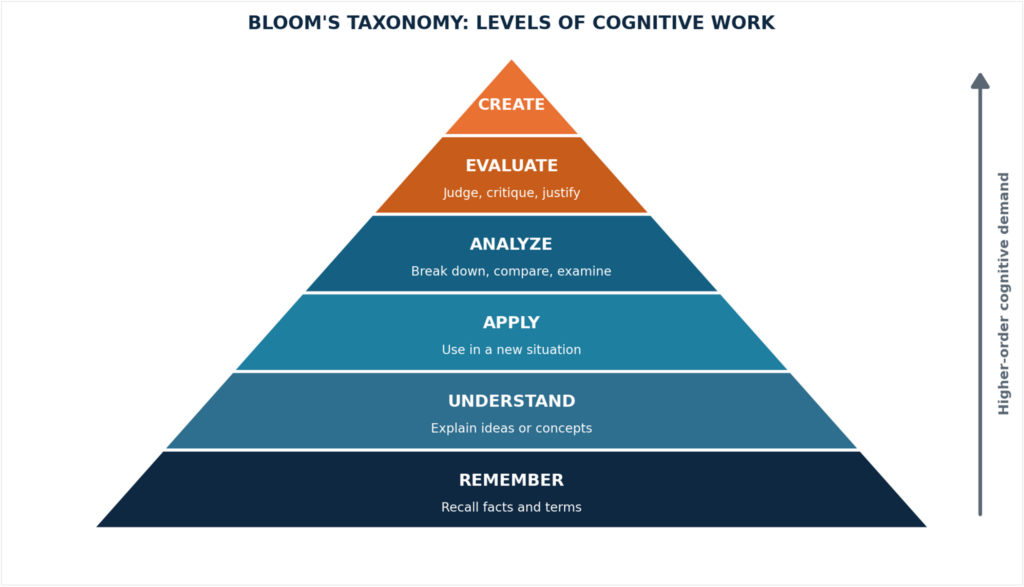
The critical point is that the outcome, the assessment, and the learning experience must operate at compatible levels.
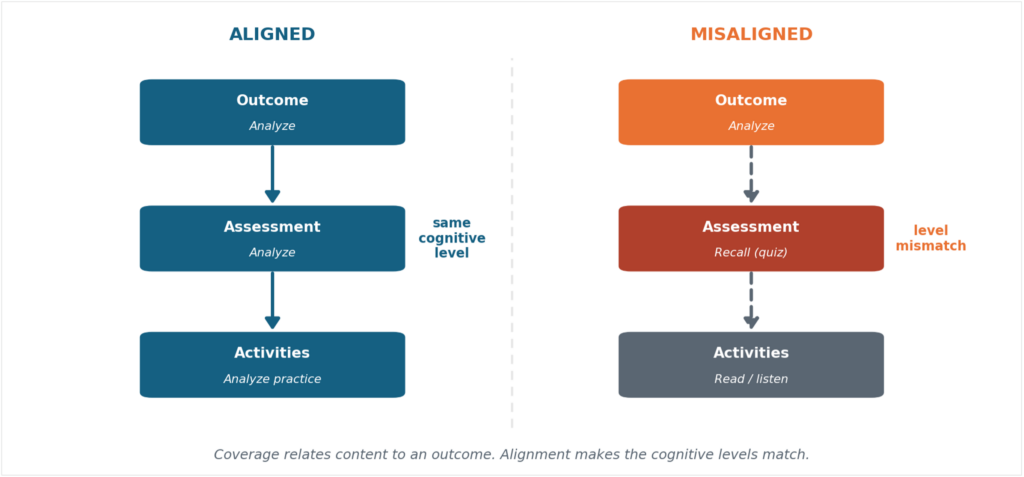
If an outcome asks students to apply a framework, the assessment should require application, not simply recognition of the framework’s definition. If an outcome asks students to analyze evidence, students should practice analysis before they are evaluated on it. If an outcome asks students to synthesize ideas or create an original product, a multiple-choice test focused on recall is unlikely to provide sufficient evidence that the outcome has been achieved.
That does not mean multiple-choice questions are inherently low-level. Well-designed selected-response items can sometimes assess application or analysis. The issue is not the format alone; it is the cognitive work the student must perform. Still, when the stated outcome requires students to produce, design, demonstrate, evaluate, or create, the assessment should give them an authentic way to do so.
Alignment also requires instructional support. It is not enough to write a higher-order outcome and assign a complex final project. Students need a learning pathway that prepares them for that work. They may need examples, modeling, guided practice, feedback, opportunities to revise, and progressively more independent application. Content, lectures, and activities should serve as scaffolding between the outcome and the assessment.
Across the LMS landscape, we are seeing significant investment in artificial intelligence. Much of the conversation focuses on content generation, course building, feedback, efficiency, and student support. Those are important use cases. But I would like to see LMS vendors go further and use AI to help faculty examine the alignment of their courses.
In much the same way that we provide rubrics to students so they can understand the expectations of an assignment, LMS platforms could provide faculty with an alignment framework that makes the expectations of intentional course design more visible.
Imagine an LMS that could review a course’s stated outcomes, assessments, activities, lectures, and resources and help the instructor see the relationships among them. It could flag outcomes that are not measurable or observable. It could identify outcomes with no associated assessment, or assessments that do not appear to measure any stated outcome. It could compare the cognitive level of an outcome with the demands of the assessment and note potential mismatches. It could identify places where students are expected to perform a complex task without sufficient practice or feedback. It could also point out unnecessary duplication, weakly connected content, or overreliance on one assessment type.
Transparent, explainable, editable, and firmly under faculty control—not a machine grading pedagogy.
The goal should not be to have AI “grade” faculty or dictate pedagogy. Alignment is contextual, and disciplinary expertise matters. A machine cannot fully understand the purpose of a course, the characteristics of its learners, or the professional judgment of the faculty member. Any such tool would need to be transparent, explainable, editable, and firmly under faculty control.
But AI can help make patterns visible. It can ask useful questions, reduce the manual burden of mapping, and provide a starting point for reflection, peer review, instructional design consultation, program assessment, and continuous improvement. Most importantly, it can help move outcomes from the margins of the LMS into the center of the learning experience.
This would also benefit students. When outcomes, assessments, and learning activities are clearly aligned, students can better understand why they are doing the work. They can see how an activity prepares them for an assessment and how that assessment connects to the larger purpose of the course. Expectations become clearer. Feedback becomes more meaningful. Learning becomes less about completing disconnected tasks and more about developing demonstrable knowledge, skills, and capabilities.
We already have much of the data needed to support this work inside our LMS platforms. Outcomes, assessments, content, activities, rubrics, grades, feedback, and performance data are often there. The opportunity is to use these elements not merely as separate features, but as parts of a coherent instructional system.
The next generation of LMS innovation should not only help faculty produce more content or build courses faster. It should help them build courses more intentionally.
The central question should not be, “Did we cover the material?” It should be, “What should students be able to do, what evidence will show that they can do it, and how will the course help them succeed?”
When we design in that order, beginning with outcomes, moving to assessments, and then developing the content and experiences that support them, we create courses that are more coherent, more transparent, and more focused on learning. AI has the potential to help faculty see and strengthen that alignment. LMS providers should make that potential a priority.
Be sure to follow Matt Winn on LinkedIn to catch all his great industry insights.