

Analyst
Tambellini Author
Higher education is absorbing pressure from nearly every direction all at once. The pool of traditional-age students is shrinking. Political scrutiny of funding, curriculum, and institutional autonomy has intensified at the state and federal levels. Students and families want proof that a degree pays off, and employers are asking whether graduates are ready for a workforce that is rapidly evolving. On top of all of this is artificial intelligence, a rapidly evolving technology that touches teaching, research, and operations all at the same time.
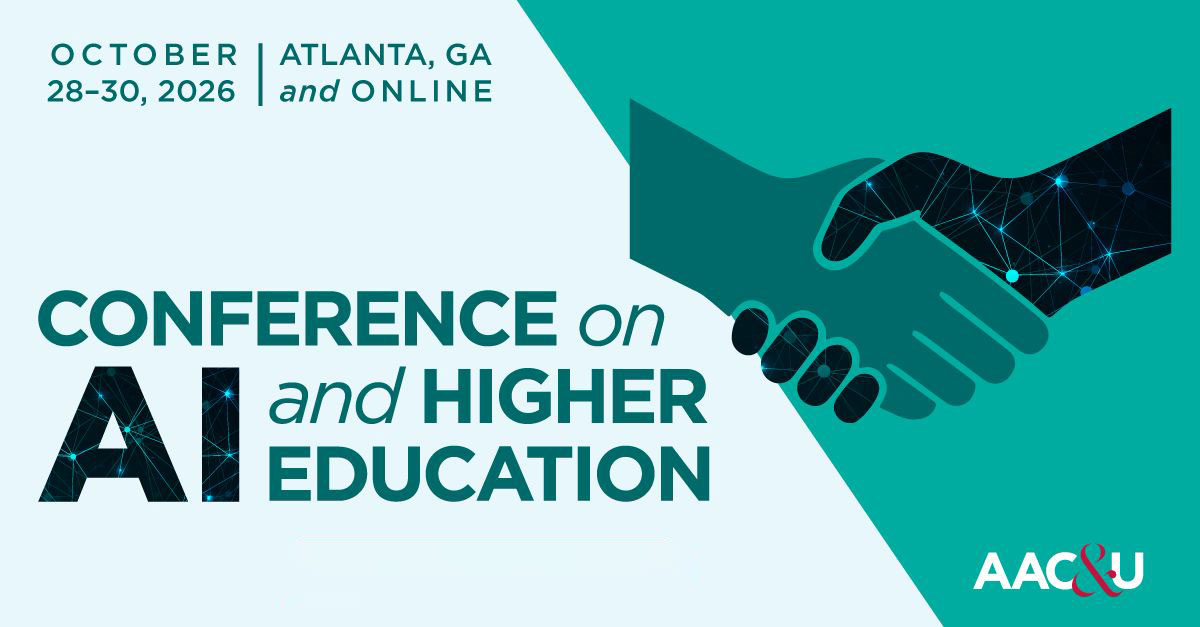
Against that backdrop, the American Association of Colleges and Universities (AAC&U) hosted its inaugural Conference on AI and Higher Education, October 28–30, 2026, in Atlanta and online. AAC&U framed the event around responsible AI adoption, institutional governance, and implementation, with a stated goal of helping campuses move from isolated experimentation toward coordinated, institution-wide strategy. At the Tambellini Group, we speak with institutions almost daily and conduct ongoing research into how they are using AI. The conference added another vantage point: a chance to hear from a broad cross-section of campuses at once about how they are approaching AI on the ground, away from vendor pitches and headlines.
The program opened on Wednesday with preconference workshops, the first concurrent sessions, an opening plenary, and an evening poster reception. Approximately 1,900 higher education professionals attended the conference in person and online, representing institutions in the US and around the world. AAC&U also received a record 966 session proposals for its first event. Sessions ran across six tracks: academic integrity; the future of work and the professoriate; institutional operations and transformation; policy, governance, and ethics; student success and the co-curriculum; and teaching, learning, assessment, and curricular reform. Formats ranged from panels and roundtables to rapid-fire Pecha Kucha presentations and theory-to-practice workshops.
What stood out most was who was in the room. Faculty sat next to provosts and presidents. IT leaders, librarians, student affairs professionals, researchers, and administrators shared tables. Students were there too, and they were invited to co-produce solutions. On the opening plenary’s student panel, most said they use AI for routine tasks such as emails and budget spreadsheets but want to do the analysis and thinking themselves. Several asked colleges to teach them how these systems work and who builds them. Conversations about academic integrity, assessment, and AI policy sound different when the people those policies affect are part of the discussion. That cross-functional mix is rare at higher education technology events, which tend to separate the academic side from the administrative and technical sides of the institution. Here, they were working on the same problem, together.
Institutions at the conference are putting AI at the center of institutional strategy rather than treating it as a side project or something to wait out, and many are working across institutional lines to find a path forward. The tone was less “Should we?” and more “How do we do this well, and together?” Once AI moves from a pilot run by a few enthusiasts to a strategic priority, it competes for budget, staff time, and leadership attention, and it needs the governance that comes with that status.
What gave that strategy its direction was mission. Attendees were candid that enrollment declines, political scrutiny, and questions about return on investment are not going away.
Rather than retreat, many institutions are using this moment to recommit to a shared core purpose: producing an educated, productive, and responsible populace.
AI strategy was most convincing when it was framed as a way to serve that purpose, not as a technology initiative on its own. AAC&U President Lynn Pasquerella set that tone in the opening plenary, arguing that AI strengthens the case for liberal education and that educational purposes should guide technology choices, not the reverse. And whatever the session topic, whether governance, operations, or pedagogy, the discussion kept arriving at the student: what students need to learn, how they learn, what they will face after graduation, and how AI shapes their experience along the way. That common thread ran through all six tracks, and it offers a practical test for any AI investment.
Mission also has to hold steady while everything around it moves. The novelty of AI is a challenge, but the speed at which capabilities evolve is the bigger one. A policy written last spring may already be out of date, and a tool adopted this fall may look very different by next year. Several sessions explored how to make the whole enterprise more agile, diverse, and responsive, so institutions can absorb rapid pivots without starting over each time. José Antonio Bowen, senior fellow at AAC&U, offered one practical approach in his Thursday keynote: base syllabus and assignment guidance on enduring principles that can be applied to each new tool, because rules written for specific tools go stale quickly.
None of this momentum came without caution, and the caution was well grounded. Environmental impact, equity of access, effects on employment, copyright, cognition and learning, and academic integrity were all top-of-mind concerns. Faculty share those worries. In an AAC&U and Elon University survey of more than 1,000 faculty, 90 percent said AI will diminish students’ critical thinking, even as 61 percent saw potential for AI to enhance and personalize learning. These concerns were not raised to stall progress. They were raised as conditions for doing AI responsibly. Institutions that build these questions into decision-making from the start, through procurement criteria, data governance, and an honest look at who benefits and who might be left behind, will be better positioned to move quickly without losing the trust of their campus communities.
If strategy is set at the institutional level, much of the real work happens in courses and curricula. Assessment was the clearest example.
There is broad consensus that AI detection tools are not effective, at least for now, and leaning on them risks false accusations and eroded trust between students and faculty.
The answer, repeatedly, was to redesign assessment rather than police it. In practice, that can mean more weight on process, drafts, reflection, oral components, and applied work that shows how students think, not just what they submit. Bowen made the case with evidence. In one study of 26,000 high school students, unguided AI use cut homework time and raised homework grades, but test scores fell. A purpose-built tutor that withheld answers and asked more than it told produced better results. The design made the difference. Champions exist at institutions of every size, but larger institutions are experimenting fastest and sharing what works so others can adopt or test it.
That redesign ultimately rests with faculty. Many institutions have overarching AI policies, but individual faculty decide how AI is handled in their courses. Whether an assessment is no-AI, AI-assisted, or fully AI-integrated is largely a faculty call. That autonomy is appropriate, and it respects real differences across disciplines, but it puts a heavy load on faculty, who are expected to keep pace with tools that change every few months on top of teaching, research, and service. One-time workshops will not be enough. Institutions will need sustained investment in training and professional development, with budget and staff time to match, and they will need to recognize this work in workload and evaluation decisions, so it does not become an unpaid add-on.
Students are also getting a more structured introduction to AI. Several institutions are piloting some form of AI course for incoming first-year students. Some offer it for credit; others deliver it as a noncredit online course tied to a microcredential. The format is far from settled, but the direction is clear: AI literacy is becoming part of the first-year experience. Agnes Scott College, for example, rolled out a required AI curriculum this fall for all first-year students. It spans both semesters and covers how AI works, ethical debates, academic integrity, and careers. Over the next few years, the data from these pilots will be worth watching, especially on whether students prefer AI-enabled courses to courses without AI and how that preference relates to learning outcomes. Institutions will also have to decide who teaches these courses, how the content stays current, and how it connects to the discipline-specific AI use students will encounter later.
All of this puts pressure on how quickly curriculum can change. Higher education is taking a hard look at itself, and multiyear curriculum review cycles do not fit a technology that changes this quickly. Institutions are building internal resources, such as teaching centers, instructional design capacity, and faculty learning communities, to increase how often curriculum, content, and delivery are updated. The institutions that make the most progress will likely treat curriculum review as continuous work supported by shared resources, rather than a periodic event each department manages alone. That has implications for technology teams too, whose learning platforms, content tools, and analytics will need to support faster, more frequent course revisions.
Shadow AI is a big risk. Across campuses, there is a remarkable amount of creativity: tools, engagements, and experiments already in production. But many are built on free or personal AI accounts.
In most cases, this is not defiance; it is a gap. Institutions have not provided adequate approved tools, resources, or guidelines, so faculty and staff fill the gap themselves. Although most institutions have some form of governance outlined in a policy, experimentation is happening outside these guidelines. One large public university shared a candid measure of the gap: only about 10 percent of people with paid institutional AI accounts use them daily, while roughly 4,000 people use ChatGPT with their university email, mostly on free accounts. This is a serious exposure. When student or institutional data flow into unmanaged tools, institutions lose visibility into where data go, how they are used, and whether privacy obligations are being met. The exposure also extends beyond chat tools. Faculty and staff are now using AI to build their own vibe-coded apps, and some of those apps quietly become tools that colleagues depend on or that handle moderate- or high-risk data. Institutions often do not know these apps exist, and if the person who built one leaves, nobody may know how to maintain it. The fix is less about enforcement and more about giving people sanctioned, well-supported options that are as easy to use as the free ones.
Mississippi State’s broader approach is worth studying because it governs AI without a separate AI policy. Julie Jordan, senior advisor for AI and data governance, reports to the president and argues that existing IT and information security policies already protect institutional data; AI simply reaches those data in new ways. A standing data governance committee meets monthly and issues guidelines that carry the force of policy, published on a website so they can change quickly. Data fall into three risk levels, with a rule anyone can remember: if you have to log in to reach it, treat it as sensitive. Jordan also listened before she governed, holding about 25 workshops and roundtables and growing an AI community of practice to more than 800 members.
Structure is often the bottleneck. Montgomery County Community College’s six-person AI team has spent a year on surveys, faculty training, and roundtables and presented a recommended structure to the cabinet in October, yet it still has no formal authority or dedicated funding. The presenters said many peer institutions are in the same position. Their session compared four ways to organize AI work: decentralized faculty networks, a central council or task force, a hub-and-spoke model, and an executive-led initiative. No single model fits every campus, but leaders have to choose one. One detail deserves more attention than it got: the college paused a Microsoft Copilot pilot because its data were not classified well enough to keep the tool from surfacing information it should not. For many institutions, AI readiness will depend on data readiness.
Much of this work lands on IT. Bryan Alexander, senior scholar at Georgetown University, noted in the closing plenary that IT departments that were already stretched thin now face enterprise AI licensing and support as well.
Institutions also need to plan for vendor volatility. When an attendee asked what happens if campuses invest heavily in products from AI companies that later fail, Alexander advised building backup plans, making sure institutions can get their data out, and considering open-source options.
Those protections are easiest to secure when they are written into contracts from the start.
The inaugural conference showed a sector that has moved past the question of whether to engage with AI. The work ahead is about how institutions organize themselves to keep up: governance that can adapt quickly, sustained investment in faculty, approved tools that reduce the pull toward shadow AI, curriculum processes that move at a new pace, and data that are classified and governed well enough for AI to use them safely. None of that can sit with a single office. AI touches academic affairs, IT, student affairs, the library, research, finance, and HR at once, and the strategy must reflect that.
Mission must anchor the work. Institutions that tie AI decisions to what they exist to do and to the students they serve will make better choices about where to invest, where to experiment, and where to hold back.
There is one more challenge that deserves attention. Across higher education, there are people who remain very cautious about AI, and some who are opposed to it. Those voices need a seat at the table. The resistance is substantial. One dean estimated that about 75 percent of the faculty in her division are actively resisting AI. At another institution, faculty asked for a campus conversation about AI skepticism, and the AI team leading that work acknowledged it had not made enough room for skeptics. Leaving them out does not make their concerns disappear; it pushes AI use and AI resistance into separate corners of the institution, where risks grow unseen. An institution where one department builds with personal AI accounts while another refuses to engage at all is not managing risk. It is spreading it. Bringing skeptics into governance and planning surfaces real concerns early, strengthens policy, and builds the trust institutions will need for the changes ahead.
AAC&U’s first conference on this topic made a strong case that the path forward is collaborative. The next step is for institutions to carry that same cross-campus approach home. AAC&U’s next Conference on AI and Higher Education is scheduled for November 3–5, 2027, in San Juan, Puerto Rico.
Share Article:


© Copyright 2026, The Tambellini Group. All Rights Reserved.
Get exclusive access to higher education analysts, rich research, premium publications, and advisory services.

