
Analyst
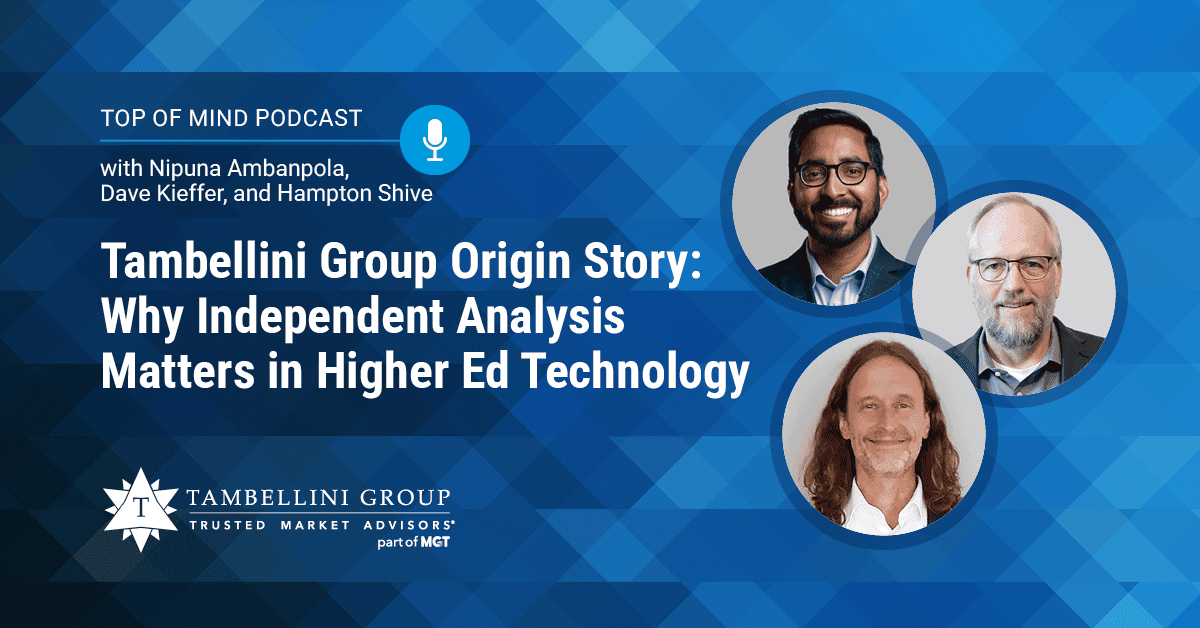
Top of Mind with Tambellini Group returns by turning the microphone on itself. Founded in 2001 by Vicki Tambellini, an education software veteran who saw buyers struggling to make well-informed, long-term technology decisions, the Tambellini Group has spent 25 years as an independent, neutral voice between the institutions that buy higher education technology and the vendors that sell it.
In this origin story, host Nipuna Ambanpola talks with Senior Vice President Hampton Shive and Principal Analyst Dave Kieffer about why independence matters when nearly everyone is selling something, why leadership and culture separate institutions that move forward from those that stall, and how the firm’s research is evolving in 2026.
00:16:18 – 00:42:11
Nipuna Ambanpola
Hello and welcome to Top of Mind with Tambellini Group. I’m your host and analyst at the group. If you’ve listened before, welcome back. Our podcast Top of Mind with the Tambellini Group is returning, and we are kicking things off by turning the microphone on ourselves. The group is an independent research and advisory firm focused exclusively on higher education technology.
00:42:18 – 01:08:19
Nipuna Ambanpola
And in this episode, you’ll get to know the people and the organization powering that research. And today, I’m very excited because I’m joined by two colleagues, Hampton Shive, who serves as the senior vice president, and Dave Kieffer, principal analyst at the Tambellini Group, to talk about who we are, how we work, and why independence matters in a market where nearly everyone is selling something.
01:08:21 – 01:13:04
Nipuna Ambanpola
So, Hampton and Dave, thank you so much for being here.
01:13:07 – 01:14:21
Dave Kieffer and Hampton Shive
Thank you. And be here.
01:14:24 – 01:31:25
Nipuna Ambanpola
Yeah. So, all right, I’m going to, you know, start with a prompt. Right. Hampton I’m going to direct that to you. Tell us a little bit about the Tambellini Group. Right. Who are we and what is our origin story? And I’m kind of pitching this to you. Taking into consideration that I am also relatively new to the group.
01:31:27 – 01:39:06
Nipuna Ambanpola
You know, I’m finishing my seventh month here. Tell us a little bit about who we are and what our origin story is.
01:39:08 – 02:18:10
Hampton Shive
Great question. Thanks for the opportunity to talk a little bit about our team. And you really set it very succinctly when you said Tambellini Group is an independent research and advisory firm focused exclusively on higher education technology. what does that really mean? So, Tambellini Group is a team of lifetime practitioners across higher ed who are very, very passionate about bringing objective analysis around higher ed technology solutions and services.
02:18:16 – 02:53:21
Hampton Shive
We spend a tremendous amount of time doing primary market research with both institutions and vendors to understand what the landscape looks like across ad tech solutions. So, if that’s what we do today, how did we get here? Tambellini Group was founded in 2001 by Vicki Tambellini. And Vicki’s history was in software and education, technology, software and being a part of vendors.
02:53:24 – 03:39:04
Hampton Shive
Vicki really began to see some of the challenges that buyers faced in making wel-informed decisions, and it really, really pushed her to build a small team and a set of assets that provided additional resources for buyers when they were making very impactful software selections that would have long-term implications for their environments. And so, from 2001 forward, essentially, Tambellini has been a sustained, independent and neutral voice around what sellers are doing.
03:39:05 – 04:13:12
Hampton Shive
I what ed tech vendors are producing, their strategies, their roadmaps for their, their technology. And then we pair that with knowledge of what institutions are seeking. So having these close relationships with both the buyers and the sellers gives us a very, very comprehensive view of what is happening in the market. Now, the fact, as you said, that we are not aligned with any particular technologies or vendors.
04:13:15 – 04:43:15
Hampton Shive
It gives us the freedom to speak very, very openly and objectively about what we see happening in the market. So, in a nutshell, Nipuna, we are sitting between the producers and the consumers of edtech technology. We are sitting in a neutral position, and our objective is to provide the most unbiased and deep analysis that can inform both buying and selling decisions.
04:43:17 – 04:46:12
Dave Kieffer
Yeah. Okay. It’s. It’s Tory time.
04:46:15 – 04:48:21
Nipuna Ambanpola
Okay. Please go for it.
04:48:23 – 05:14:10
Dave Kieffer
So, Hampton, thanks for that great explanation. I want to tie this to some specific history, because one of the things that you mentioned, Hampton, is we’re a team of practitioners, and I want to take story time back to 1995, when Vicki Tambellini was the VP of sales, that people soft and I was a lowly manager of some sort in Ohio State technology when we bought PeopleSoft.
05:14:12 – 05:37:01
Dave Kieffer
And our connection goes. I didn’t know her that our connection goes all the way back to that time when she was selling PeopleSoft to higher education institutions, and I was at a buying organization and spent the next now 30 years dealing with enterprise ERP technology. That was the beginning of it for me. It was 95 and 96 through all this time in history, through different projects.
05:37:01 – 05:58:06
Dave Kieffer
And now my time at Tambellini. So, it’s I think it’s an important point that the threads and higher ed run long and deep. A lot of us and a lot of you all have a lot of connections to each other throughout this industry. And I think that that history and those connections actually matter quite a bit in our ability as analysts to step back from what’s happening today and say, wait a minute.
05:58:07 – 06:15:02
Dave Kieffer
This looks a lot like a pattern that I saw X. And I think the age of AI brings all that forward. So, I think it’s really interesting as we think about how these things get threaded together between the personal stories of those of us that have been in the industry for a long time and how this organization got built.
06:15:08 – 06:28:21
Dave Kieffer
I still remember that first student report that Vicki’s team produced when I was on on the other side. We didn’t we didn’t buy it. I think we had already purchased Campus Solutions at that time. But I still remember that first report coming across the wire.
06:28:23 – 06:51:08
Nipuna Ambanpola
Yeah. And I mean, you know, to be honest with you, this is intentional, right? Because high is not like any other industry. Right. It it dry. You know, it’s really built on trust. Right. And there are nuanced, you know, multifaceted things that affect every single institution students, you know, and certain success is at the center of everything that we’re trying to do.
06:51:08 – 07:14:26
Nipuna Ambanpola
So, I think, you know, even the group, you know, from everything that you said, Hampton and Dave, I think it’s a very intentional setup to be neutral, independent, trusted advisors in this market. Right. And that’s what I think the value is. So, you know, to what came about, independent and industry analyst. Right. So, tell me, a little bit like Dave, I kind of want this to you.
07:14:26 – 07:28:09
Nipuna Ambanpola
Right. Like tell me a little bit about what does an industry analyst see. Right. That a vendor, you know a single institution can’t. And what does that look like. Right. Tell us a little bit about who is an industry analyst.
07:28:11 – 07:55:09
Dave Kieffer
This is one of the hardest questions that we answer because it’s a multifaceted role. When I try to explain to people what my day looks like, they’re kind of like, you do all those things in one day and all parts of some of them. So let me start with the institutional side of this. We spent a lot of time with institutions, both who are clients and who are not our clients, understanding not only what are they doing with technology today, but where are the gaps, where are they trying to go?
07:55:16 – 08:16:05
Dave Kieffer
What? Looking forward, what do institutions need? We spend a lot of time trying to figure this out, along with the folks, the leaders from institutions that we talked to. And so, as Hampton mentions, our primary research, that’s one big arm of that research, which is what’s happening in institutions. What are the dynamics, what are the forces on institutions?
08:16:07 – 08:41:09
Dave Kieffer
And I know we can all say, since especially since 2020, the forces impacting higher education have shifted more quickly and more deeply than any other time that I’ve been in this industry for for 40 years. So that’s that’s one big part of it is to kind of read the tea leaves and understand what the need is, what our actions being taken by institutions, how are they making those decisions to try to to get a really good understanding of that side of the landscape.
08:41:15 – 09:09:23
Dave Kieffer
And the other side is this this vendor side of software vendors, implementation partners, all kinds of service providers who are providing these things to institutions and understanding what are they selling? How was how is what they’re selling shifting in the age of AI? Right. We’ve seen this motion happen very, very quickly of what they’re selling and how they’re selling it to institutions has shifted dramatically.
09:09:25 – 09:31:11
Dave Kieffer
What are the mechanisms and economics happening inside those vendors to really understand why they’re doing what they’re doing, how they’re doing it, how effectively they’re doing it. So, part of our job is to try to take all that information in and bring that back to the buyer side of the market in some logical way, that that helps them understand who they’re buying from and what they might be buying.
09:31:14 – 09:51:19
Dave Kieffer
And then I want to layer on one other angle of this, which is we have to understand the technology industry at large. We can’t only focus on what’s happening in higher education, because many of the vendors and the forces and the technologies that that higher ed is interested in or not interested in, but being forced towards, are being developed outside of our industry.
09:51:22 – 10:10:25
Dave Kieffer
And I think that’s certainly always been true. I think it’s more true now than ever that the, the general technology forces that are broader than us are impacting us more and more every year. And we also have to try to translate for those who are maybe more insulated within higher ed, what’s happening outside of it, that that could be an impact.
10:10:25 – 10:24:19
Dave Kieffer
So, that work is happening in all of those dimensions on a daily basis as we try to understand and distill kind of what’s happening in the market. As a simple question based on all those dynamics.
10:24:22 – 10:50:20
Hampton Shive
Dave, it’s interesting when you say what’s happening in the market, immediately my mind goes to some of the work that you and other members of the team have done around identifying trends. I think this is particularly relevant today because so many things are shifting. The question is, what’s new? What’s repeating from cycles that we have seen before in the past?
10:50:25 – 11:19:04
Hampton Shive
And I really want to tie this in with our position as being neutral and independent, being on the buying side for decades, I was very accustomed to being pitched things by vendors, and frequently they would tell a narrative of their vision of where a market space or a technology was heading. And a lot of times what they were sharing with me, I found highly believable.
11:19:09 – 11:49:24
Hampton Shive
At the same time, I was also aware that they were representing products and services, that they were investing and building and then working to monetize. And you hear things from vendors, good information, but how do you hold those things up against each other and truly be objective around what you are hearing? It’s very easy for vendors to slip into marketing speak.
11:49:26 – 12:28:16
Hampton Shive
It’s also very refreshing when you hear vendors that are completely honest about whether they are strong in that area or not strong in an area, but that’s not always the norm. But you can always count on our team to come to the conversation with the objectivity. It’s not just the objectivity, but it’s also really an eye toward where are things moving and how do we make sure that we position ourselves to arrive as opportunistic moments when they are appropriate for us?
12:28:16 – 13:11:17
Hampton Shive
So it’s a constant balancing between opportunity and risk. These are topics that are nuanced, and sometimes you want an objective partner, active thought partner, to be able to talk through a lot of these topics, challenges, ideas. I would say that that’s where our analysts absolutely thrive, is in this ambiguity of what cannot be clarified by a singular vendor but can be illustrated with a much more clear picture painted by a team of objective and neutral analysts.
13:11:19 – 13:33:23
Dave Kieffer
And I would add experience to that, because the other lens here is, as you mentioned, most of us on this team have been doing this from the buying side and the operations side for decades. And there’s two ways you can take that. One is you’re steeped in the way that we’ve always done things. And as we try to change the market, the vendors are pushing in a certain direction.
13:33:27 – 13:53:10
Dave Kieffer
You can’t you can’t see ahead far enough. But I think what I can say with high confidence is that this team of people are all people who have been change leaders on those campuses and found ways to apply new technologies and creative ways and look ahead, and not just to the way that we’ve done things, but what could this look like if this technology applied?
13:53:10 – 14:29:24
Dave Kieffer
Well, in the circumstance where institutions are budgetary constrained and AI is is taking place, and there’s a change curve that’s higher than it’s ever been, and all of these factors that that aren’t kind of baked into the way that higher ed operates today, but seeing the places where change could happen. I’ll tie it back to a theme we’ve had for a couple of years, is looking at the agility of higher education and the fact that even though we’ve been challenged for decades to do things better and do things faster and do things cheaper, there’s still a lot of inertia in how higher ed operates.
14:29:26 – 14:53:06
Dave Kieffer
When we talk a lot about what does it take to build an agile, higher ed organization from operations perspective, even an academic perspective? That’s bigger than any one of these vendors, right. So, I think it’s the tying of this vision of how the industry ought to operate, along with the reality of the constraints that we know they’re under and those available technologies to help move them.
14:53:11 – 15:00:19
Dave Kieffer
That’s the stuff that is hard to come by without some of the experience that you see on the team.
15:00:21 – 15:03:03
Hampton Shive
Dave you’re sorry.
15:03:06 – 15:07:09
Nipuna Ambanpola
Go ahead. I you know this is great I love this conversation. Please go ahead.
15:07:11 – 15:43:26
Hampton Shive
You’re describing something that there is a tension between the inertia of higher ed which is headed in one direction based on history. There’s a tension between that and the demands of many different layers. That could be demands of institutional changes. It could be changes in community or society at large to where is the mission of higher ed that we have known for decades, centuries, for that matter?
15:44:01 – 16:15:27
Hampton Shive
Is it still aligned with what the market is asking for and what the market needs? And so with the shifting that we’re seeing happening more rapidly than ever, I see this need for there to be a trust layer that may not necessarily be present across all of the layers of marketing that were exposed to when we’re looking at different solutions.
16:15:29 – 16:54:11
Hampton Shive
And I’m thinking about this idea, what you mentioned around change and change rate, and thinking about the relevance of being able to go into new mindsets, new architectures, new approaches to rethinking tiny aspects of the institution all the way up to the institution as a whole, and how the marketplace of ed tech vendors can help support small or monumental changes within institutions.
16:54:13 – 17:41:12
Hampton Shive
And so typically from the buying side that is received in terms of pitches around products or services. But you’re really, really touching on this deeper theme of the fundamental culture and cultural change that’s happening within higher ed, and maybe some of these different velocities that impact buying decisions and change decisions. And so, would you mind just speaking a little bit more to that, this differential around the pace at which we’re moving and how these can be brought together in a way that is healthy for both the buying side and the selling side of the equation?
17:41:14 – 18:00:23
Dave Kieffer
This is a huge stressor on the folks that we work with. I’m thinking of a specific client that I was working with this week who was trying to make change, trying a group of people really trying hard to make change on their campus. And there are two things that are holding them back. Well, I would say three things.
18:00:27 – 18:20:02
Dave Kieffer
One is they’re under budget duress, right? They’re having to make budget cuts and they’re trying to reinvent themselves in a certain domain. At the same time, this is very difficult work. Number two, there are operational things that go wrong on every campus every day. So, I got on the phone with this leader yesterday and he got and he said, okay, I need to take a breath.
18:20:04 – 18:40:27
Dave Kieffer
I’m fighting fires this morning. This is my forward-looking thing that I needed time with you to talk about. But it’s really hard to do because I’m firefighting all morning. But I didn’t think I was going to have to do so. There’s taking care of the operations that’s happening. And the other piece is this cultural layer that I think today varies across institutions more than it ever has.
18:40:29 – 19:08:17
Dave Kieffer
So we have what I would call kind of visionary institutions with visionary leadership that see a path forward, have cast off some of the practices of higher ed that kept us from moving ahead and created space for people to innovate and move forward, even in times of budget cuts and difficulties. And at the very other end of the spectrum, we have institutions that don’t have that same kind of leadership that builds space to be agile and make movement.
19:08:19 – 19:35:11
Dave Kieffer
And I think the leadership and cultural parts of this are the differentiators between the campuses, who can and do move forward in a certain way and the ones that can’t, because we have seen visionary leadership unite together across multiple customers, can cause the chains of that cultural legacy to start to drop off for people. And those that want to step forward can step forward, and those that don’t step away, frankly, on those campuses.
19:35:14 – 19:58:27
Dave Kieffer
But it’s the number one differentiator between those institutions that really start to thrive culturally on moving forward and finding their moment in this space in this time. And those that are really that really struggle to bring the kind of change that I think back to the cultural moment that we’re in requires of higher education to survive and thrive.
19:59:00 – 20:14:10
Dave Kieffer
Because the stresses are real. Does the model work? Probably in some ways. But the minute you mentioned market, because that’s what higher education has become, that changes the dynamics. And that’s that’s part of what’s what’s been changing the last 30 years.
20:14:13 – 20:34:12
Nipuna Ambanpola
Dave, I want to kind of, you know, you bring up such a good point, and I want to take that point out and turn it back on us because we let’s have a self-reflection. Right. The group is also evolving, right. Because as a response to this cultural shift, as a response to AI, as a response to the overall dynamic change in higher education.
20:34:16 – 21:02:20
Nipuna Ambanpola
So, you know, because Hampton, you just mentioned, right, we’ve started publishing a trend analysis pieces to really understand what’s happening in the market. And when we thought, you know, when we realized rather that the market is now especially the eye moving faster than trend analysis, we brought market alerts, right. To really emphasize on what’s happening in the market and how that how what implications that they have for higher education.
21:02:20 – 21:22:14
Nipuna Ambanpola
So, Hampton, I want to kind of post this to you. How is Tambellini Group evolving? Right. And for higher education institutions and vendors and, you know, even, you know, somebody kind of tuning in, just interested about the industry, how are we evolving and what’s in stock for us as we look forward?
21:22:16 – 21:59:16
Hampton Shive
That’s a great question. And you mentioned a couple of the things that are direct manifestations of the changes that we are making, which I would classify as we have really rebooted our research and publication agenda in calendar year 2026. One of the things that we’ve committed to do is to give all of our clients a much broader and deeper view into the ad tech landscape as it looks today and as it is evolving forward.
21:59:19 – 22:24:26
Hampton Shive
There are a couple of spaces where I could easily identify where. Let’s just take the student systems, for example. I think we all have an idea of what student information systems are. You know, we all have ideas about what CRM systems are, and we all could name vendors in these spaces. Well, historically these have been fairly discrete areas of technology.
22:24:28 – 22:57:19
Hampton Shive
But we start to see these blending together where a solution that historically been in space A is perhaps migrating into space B in terms of capability, and then vice versa. Solutions in B are migrating more in to space A so the the lines are blurring around technological domains. It’s our duty to our community to illuminate those shifts that we see that are happening.
22:57:21 – 23:35:08
Hampton Shive
So our analysts are now producing vision papers. This is a look far into the future. However, we want to define that two years, three years to where we are painting a picture of where we believe the shifts are occurring. At a macro level, we are supporting those by new content types around the trend analysis that you mentioned. This is where we are identifying specific things that are happening in the market that support an idea about a trajectory change.
23:35:09 – 24:08:08
Hampton Shive
You mentioned the market alerts is your very timely pieces around what specific vendors are doing. And then finally, I want to note the vendor briefings. Like all analyst firms, Tambellini does briefings with vendors. This is where vendors have an opportunity to share content around their technology, the markets that they serve, their roadmaps. And that’s a big information source for our team in terms of knowledge of the market.
24:08:09 – 24:35:24
Hampton Shive
We are now taking that information that we’re getting directly from vendors and publishing those pieces back out in our portals to give our clients direct access to what vendors are saying to us. So to summarize this, we have some of the most direct access to both the producers and the consumers of the technology. Our work is all based on primary market research.
24:35:26 – 25:03:26
Hampton Shive
So we take all of these inputs, and then we are casting a long-range vision of where things are headed, and then we are identifying trends that are supporting this longer term vision and then keep rolling that back. We are also providing very detailed information on vendors and solutions that are actually driving many of these changes and enabling new opportunities on the buying side, i.e. within institutions.
25:03:28 – 25:23:13
Nipuna Ambanpola
Yeah. That’s amazing. And you know, I’m very excited. I’m continuing to be excited about our podcast being revived as well, because to everyone listening in, we are going to have an opportunity to hear from all of our analysts, their background, their passion and how they, you know, continue to kind of evolve in this space as an industry analyst as well.
25:23:15 – 25:49:21
Nipuna Ambanpola
So. Well, Dave and Hampton, thank you so much for being here with us. And, you know, engaging in a great conversation. This concludes this episode of Top of Mind with the Tambellini Group. As I mentioned, next time when you tune in, you’ll be able to hear from our analysts. And later we’ll also talk about what shadow AI reveals about the administrative core and what unsanctioned AI use tells institutions about where their processes really hurt.
25:49:23 – 26:04:28
Nipuna Ambanpola
You can find Top of Mind on Apple Podcasts, Spotify, Amazon Music, YouTube Music, and many other platforms. Subscribe so you don’t miss an episode and explore more resources at thetambellinigroup.com. Thank you for listening.
Share Article:

If you liked this episode, this podcast is also available on Amazon Music, Apple Podcasts, Spotify, Pandora, TuneIn, and YouTube Podcasts.
Want to be a featured guest? Please contact us.
© Copyright 2026, The Tambellini Group. All Rights Reserved.
Get exclusive access to higher education analysts, rich research, premium publications, and advisory services.