

Principal Analyst
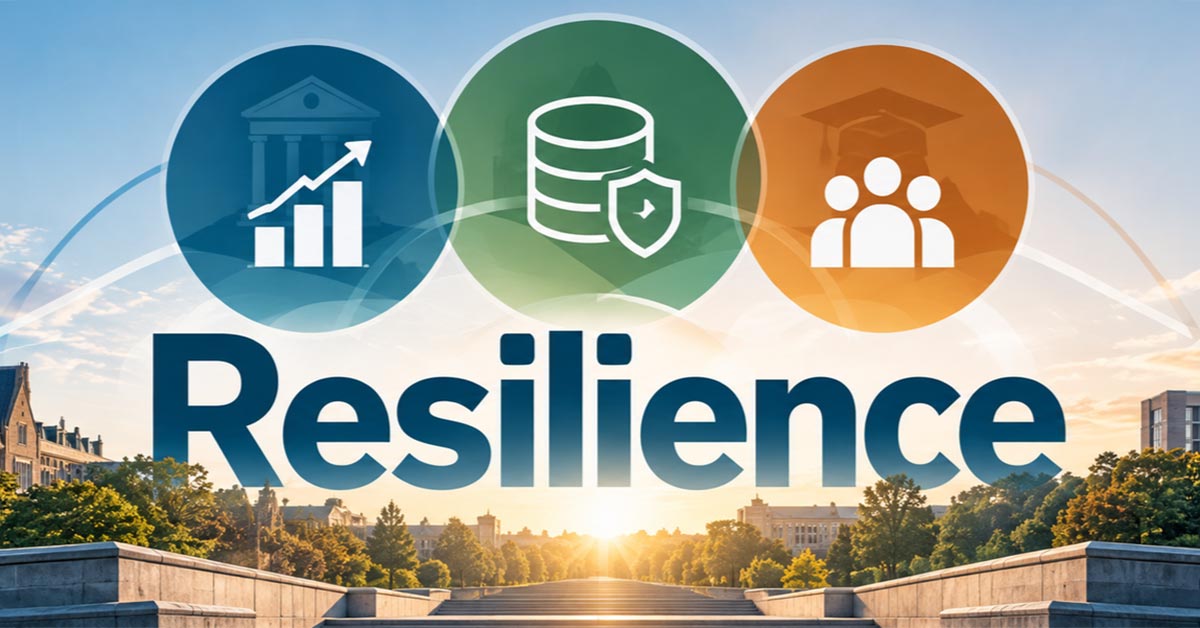
We’re nearing the end of 2026. What a ride (again!). AI is pushing us in many directions; our industry continues to be under pressure (though with more predictability than early 2025, when the new administration’s actions came very quickly), and many institutions are seeking ways to stabilize their revenue and improve student outcomes. Through all of it, I keep coming back to the same operations fundamentals that have driven much of my research for the last several years, all in the name of institutional resilience. The current trends have made these fundamentals both more complex and more achievable.
There are seven of them, grouped into three themes: business fundamentals, data fundamentals, and people fundamentals.
Enterprise planning is the practice of connecting an institution’s academic, enrollment, financial, facilities, and workforce decisions in a single model, so leaders can see how a choice in one area ripples through the rest. Building a dynamic planning environment that digs deep into institutional data allows leaders to focus on academic and student retention decisions. The model should help leaders understand the implications of changes, opening the aperture to more creative and flexible options for institutional health.
The good news is that this no longer requires a three-year implementation. Modern planning tools, many with AI arriving in the ecosystem, connect directly to institutional systems and come with models designed for higher ed, so leaders can stand up a working model in months rather than years and refine it as they go.
Cost management is the discipline of spending institutional resources deliberately, on the things that advance the mission, rather than simply spending less. Modern practices and technology can help leaders build well-managed procurement, travel, facilities, and human resource operations that balance cost, adaptability, and quality. All of these practice areas have deep opportunities for institutions that can organize themselves around institutional outcomes. However, many institutions have cut staffing to the bone, and they are not getting the quality and effectiveness from these practices and technology that drive better institutional outcomes. Cutting costs and managing costs are not the same thing. Today’s spend analytics and procurement tools can show leaders where the money goes in a few weeks. That used to take a year-long study.
Data governance decides who owns institutional data, what it means, and how it can be used. Enterprise planning, new technologies, and AI in particular all rely on institutional data being well managed and of high quality. Tackling data governance problems can accelerate quality improvement by better organizing internal data teams into data communities that solve problems faster and with higher quality (and less rework).
Data governance is a practice that much of higher ed has tried in vain to improve. There are methods to move forward, and they are primarily cultural. Building institutional control AND institutional cooperation is a difficult but not unrealistic goal. It is not primarily a technical exercise, and it must include senior leadership. When successful, the practice speeds up and ensures the accuracy of data-related work.
Data architecture is the design of how institutional data moves between systems, where it lives, and how people and tools get to it. Governance tells us who owns the data and what it means—architecture determines whether anyone can actually use it. Many institutions are still running on a patchwork of point-to-point integrations, aging data warehouses, and spreadsheets that live on someone’s desktop. A modern data architecture brings core systems (SIS, ERP, LMS, CRM) together on a shared platform with clear data definitions, reliable pipelines, and appropriate security, so that reporting, analytics, and AI tools all draw from the same trusted source.
Modernizing your architecture does not have to be a multi-year, big-bang replacement. Institutions that start with a few high-value use cases, such as retention analytics or enrollment forecasting, can build momentum and prove value while they modernize. Done well, it turns data from a compliance chore into something leaders trust enough to use.
Identity and access management makes sure the right people, and now the right systems, have the right access to institutional resources, and nothing more. Higher ed has some of the most complex identity environments of any industry: students who become alumni who become employees, adjuncts who teach at multiple institutions, plus affiliates, contractors, and researchers with access to sensitive data. Too many institutions still rely on manual provisioning, accounts that are never fully deprovisioned, and role definitions that live mostly in someone’s head.
Loose access control has always been a risk, but AI agents are about to make it an urgent one. As institutions deploy agents that read email, query student records, process transactions, and act on behalf of staff, every one of those agents needs its own identity, clearly scoped permissions, and an audit trail. An agent inherits whatever access it is given, and in an environment where people have accumulated years of excess permissions, an agent can surface or act on data far faster than any person could.
Agents are a new forcing function. Institutions that get role-based access, least privilege, and identity lifecycle management under control now will be able to adopt agentic AI more safely and quickly, while those that wait will find themselves either blocking innovation or cleaning up after it. This work also depends directly on the governance practices above, because you cannot control access to data that no one has defined or owns. Identity platforms can now automate much of this, tying access to HR and student records so it changes when someone’s role does, and the work no longer takes years.
Core HR is the set of practices that define and manage the institution’s workforce: what positions exist, what they pay, and how the people in them grow and perform. People are the largest line item in nearly every institutional budget, and yet HR is often treated as a transactional back-office function. Core HR practices such as position management, classification and compensation, performance management, and benefits administration are where the budget and the culture meet. Though we have seen a large number of institutions modernize their HR systems, there are still institutions that manage positions in spreadsheets, rely on job descriptions that haven’t been updated in a decade, and lack a clear picture of what their workforce actually costs (and what it actually does). Modernizing these practices, and the systems that support them, gives leaders the visibility to make thoughtful staffing decisions rather than across-the-board cuts. HR platforms and workforce analytics capabilities have increased substantially and have made that visibility far easier to reach than it was even five years ago, but few institutions have taken advantage of this functionality.
Just as important is a shift in posture. The most effective HR teams act as partners to management, helping leaders build flexibility into the workforce through shared positions across units, cross-training, term and project-based roles, flexible work arrangements, and clear paths for redeploying staff as needs change. Compliance still matters, but the goal is to find a way to “yes,” while respecting and investing in the workforce. Again, the tooling exists and is maturing, but higher ed practices have lagged.
Core HR connects directly back to enterprise planning. You cannot model the institution’s future without an accurate view of its people.
Talent acquisition is how an institution finds and hires the people it needs and, increasingly, how it develops them from within. After several years of hiring freezes, reorganizations, and early retirement programs, many institutions are facing real gaps in critical skills. AI is widening those gaps faster than most hiring processes can respond. Higher ed often can’t compete on salary alone, but it can compete on mission, flexibility, and meaningful work if it tells that story well and moves quickly. Long, committee-driven hiring processes lose strong candidates to employers who make offers in days, not months. Recruiting platforms with AI-assisted screening and scheduling can take weeks out of the process without compromising fairness.
Institutions that streamline recruiting, invest in internal mobility and upskilling, and think strategically about which skills to build, buy, or borrow will be far better positioned to deliver on everything above. None of these fundamentals work without the right people in the seats.
That’s my list as we head into 2027. None of these fundamentals is new on its own, but the pressure on our institutions and the pace of change around AI make getting the fundamentals right more urgent. The institutions that prove most resilient will be the ones that treat business, data, and people fundamentals as a connected system rather than a series of separate projects. When conditions change, can your institution see them clearly and adjust?
The hard part isn’t the technology. The tools have gotten faster, but institutional culture often halts inspired visions of improvement. Every week, I talk to institutions that can see a different future, but can’t see a way to get there. It takes strong leadership to bring people together to effect change, and too often, leadership fails to make the case and unite a community around a better way to run the institution. It’s hard, unglamorous work. But nothing happens on a campus that is not underpinned by core administrative processes and technology: hiring a faculty member, billing for a grant, or reimbursing business travel. These are the “hidden” functions of every institution, and they need to be efficient and agile.
Now I’d like to hear from you. Did I miss anything? Is there a fundamental you would add to the list, or one you think matters less than I’ve suggested? Where is your institution making real progress, and where are you still stuck? Share your thoughts in the comments of the original post or reach out to me directly on LinkedIn.
Originally posted by Dave Kieffer on LinkedIn. Be sure to follow him there to catch all his great industry insights.
Share Article:

© Copyright 2026, The Tambellini Group. All Rights Reserved.
Get exclusive access to higher education analysts, rich research, premium publications, and advisory services.

